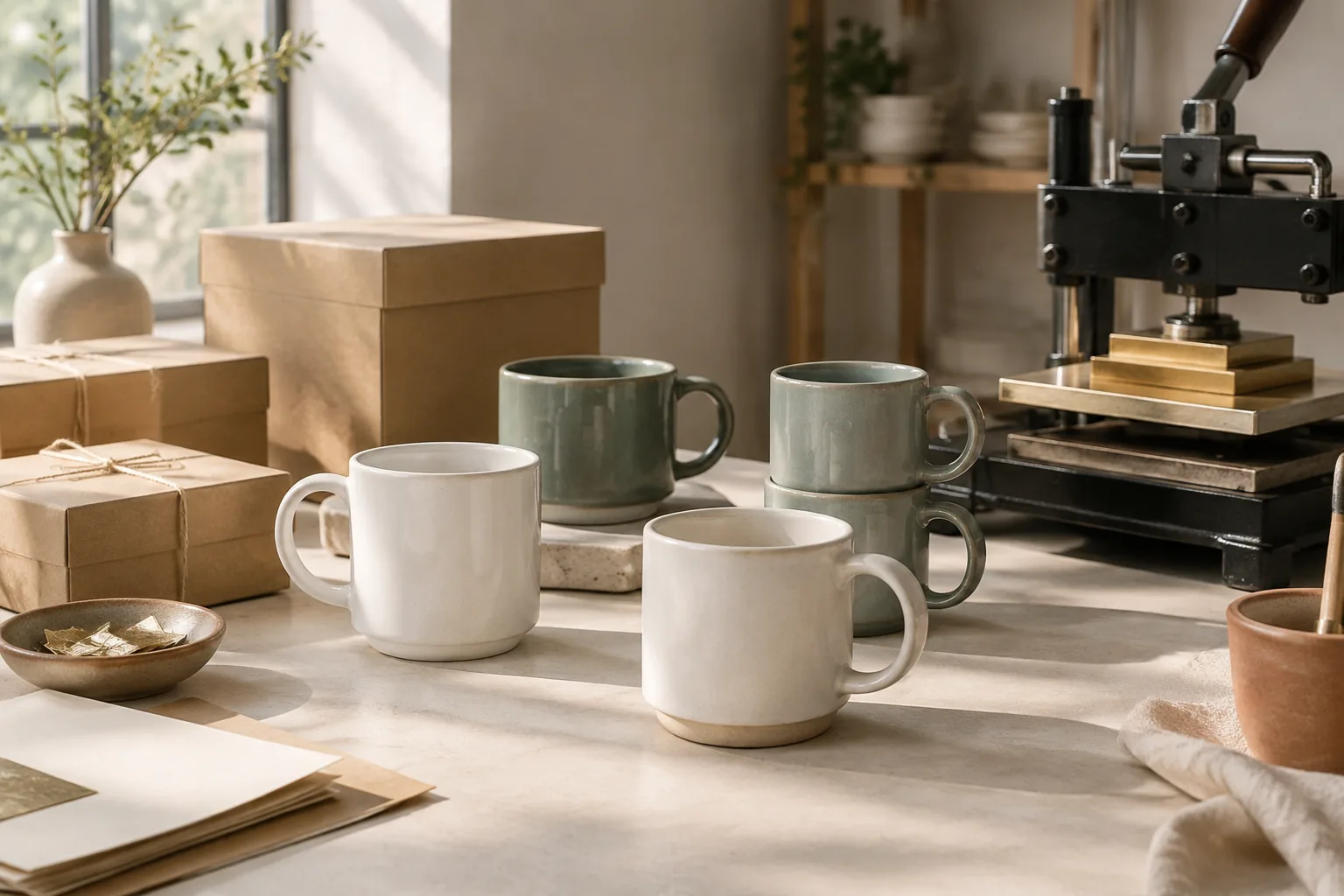
Sixteen, twenty-eight, fifty-six — dinnerware set sizes look arbitrary until you see the service logic underneath, and once you see it, line planning becomes arithmetic instead of taste. This article explains the category logic behind the three anchor set sizes, how open stock completes a line, and how to stage a branded collection so each launch funds the next.
Brands that struggle with tableware almost always struggle at the line-planning stage, not the design stage: too many shapes for the budget, set compositions customers cannot decode, no plan for the replacement piece that turns a first purchase into a decade of reorders. The category has solved these problems for decades with a small set of conventions. Learn the conventions, then decide deliberately where to break them.
The logic of 16, 28 and 56
Dinnerware set sizes encode a simple multiplication: pieces per place setting times number of settings, plus serving pieces as the set grows upmarket.
| Anchor set | Typical composition | Positioning | Example specification |
|---|---|---|---|
| 16-piece | Service for four — dinner plate, salad plate, bowl, mug per setting | The retail workhorse: gifting, first homes, ecommerce bestsellers | High-fired porcelain everyday line, typical MOQ 500 pcs per SKU |
| 28-piece | Extended service for four with added serving and prep pieces | The entertainer's set and the hospitality-grade line | Underglaze-decorated series, typical MOQ 1000 pcs per SKU |
| 56-piece | Service for eight to twelve with full serving hierarchy | Wedding, dowry and formal gifting programs | Bone china with gold rim, typical MOQ 1000 pcs per SKU |
Read the table as a market ladder rather than a size ladder. The 16-piece competes on accessibility and ships economically; the 28-piece competes on completeness and is where underglaze decoration and hospitality durability justify themselves; the 56-piece competes on ceremony, which is why it tolerates premium bodies and applied metallics kept away from eating surfaces. A new brand rarely needs all three anchors at launch — it needs one anchor done properly, with the other two visible on the roadmap.
Every shape is a SKU: the math that ambushes line plans
The set logic hides a production reality: each distinct form — plate, salad plate, bowl, mug — is its own SKU with its own development and its own minimum. A 16-piece set needs four shapes; a 28-piece adds serving forms; a 56-piece can involve ten or more. At a typical custom MOQ of 1000–3000 pieces per SKU, the piece count multiplies fast:
- 16-piece line on 4 shapes at 1000 pieces each: 4,000 pieces of inventory across four minimums.
- The same line adding two serving forms: six minimums before the second set size even exists.
- A 56-piece program on ten shapes: ten minimums, ten glaze verifications, ten packaging validations.
This is why disciplined brands launch the 16-piece anchor and let the catalog deepen on reorder data. It is also why shape reuse matters more than shape count: four forms in a proprietary glaze read as a stronger line than eight forms in stock finishes, at half the minimum exposure. Our custom program prices lines shape by shape precisely so this math is visible before commitments.
Open stock: the half of the line nobody launches
Open stock means every piece in the set is also sold individually — a spare dinner plate, a replacement mug, a second bowl. It is unglamorous and strategically enormous for three reasons:
- Replacement demand is loyalty. A customer who buys one replacement plate has already decided your line is worth keeping for years.
- Open stock de-risks the set. Buyers hesitant about a full set will trial a mug — see the mugs and cups range — and return for the set once the glaze is in their hand.
- Open stock protects hospitality accounts. Restaurants and cafés buy replacements continuously; a line without it is disqualified from that revenue by definition.
Plan open stock from day one by keeping set compositions within a fixed shape family, so the individual pieces are sellable without new development.
A staging plan that funds itself
| Stage | Launch | Economics |
|---|---|---|
| 1. Anchor | 16-piece on stock forms, your colorway or decoration | Lowest minimums (500 pcs typical per SKU), fastest market feedback |
| 2. Deepen | Open stock singles and serving pieces on the same forms | Reuses approved shapes and glaze — no new minimums per piece type |
| 3. Extend up | 28-piece entertainer set with underglaze decoration | Justifies the 1000-piece tier with proven demand underneath |
| 4. Ceremonial | 56-piece premium program for gifting seasons | Concentrated margin event; production planned against Q4 freight windows |
The staging logic is deliberately conservative about tooling: full custom molds arrive, if at all, only after stage three proves which forms deserve exclusivity. Most lines discover that a developed colorway on well-chosen forms — stage one and two — carries the brand identity on its own, and that observation is the most valuable product development lesson in the category.
Consistency rules that hold a line together
- One glaze family across the line, developed once as a banded standard — color drift between set components is the fastest way to make a line look secondhand on arrival.
- One dimensional system: diameters in mm, capacities in ml, documented so stacking, packaging and shelf photography all derive from the same numbers.
- Golden samples per shape, sealed at launch — the reorder acceptance standard for the life of the line.
- Compliance per market confirmed on the decorated, finished pieces — food-contact migration testing against FDA 21 CFR 109.16 for the US and EC 84/500/EEC for the EU, with reports available upon request.
Map your line against the anchor sets on the dinnerware sets page, then bring us the composition and target market — we will quote the shape-by-shape program with the staging above built in, starting from the quotation request.
Frequently asked questions
What does a 16-piece dinnerware set actually contain?+
The standard composition is service for four, with four pieces per setting — typically a dinner plate, a salad or dessert plate, a bowl and a mug. Some lines swap the mug for a second bowl; the constant is the 4×4 structure, which is what shoppers decode when they compare sets.
Should a new brand launch with one set size or several?+
One anchor, usually the 16-piece, with open stock singles alongside it. Each additional set size multiplies distinct shapes and therefore minimums, and demand data from the anchor tells you whether your customer wants an entertainer set or a ceremonial one next.
Why is open stock so important for a tableware brand?+
It converts one-time set buyers into repeat replacement customers, lowers the entry price for hesitant first buyers, and is a hard requirement for hospitality accounts that buy replacements continuously. Keeping your set within a fixed shape family makes open stock free of additional development.
How many shapes can a first custom program realistically carry?+
Three to four is the practical ceiling at a typical 1000–3000 pieces per SKU — beyond that, the inventory commitment and the glaze and packaging validations multiply faster than most launch budgets expect. Fewer shapes in a proprietary colorway usually outperforms more shapes in stock finishes.