Protective packaging is the cheapest insurance in the ceramics trade and the first line sellers cut when a margin looks tight — usually right before their damage rate doubles. This article puts real structure on the question: what the packaging stack on a ceramic order actually consists of, what drives its cost per parcel, how the cost scales from a single mug to a 16-piece set, and how to run the trade-off math between spending cents on packaging and losing whole landed costs to a 5–8% fragile-goods world.
The stack on a single order
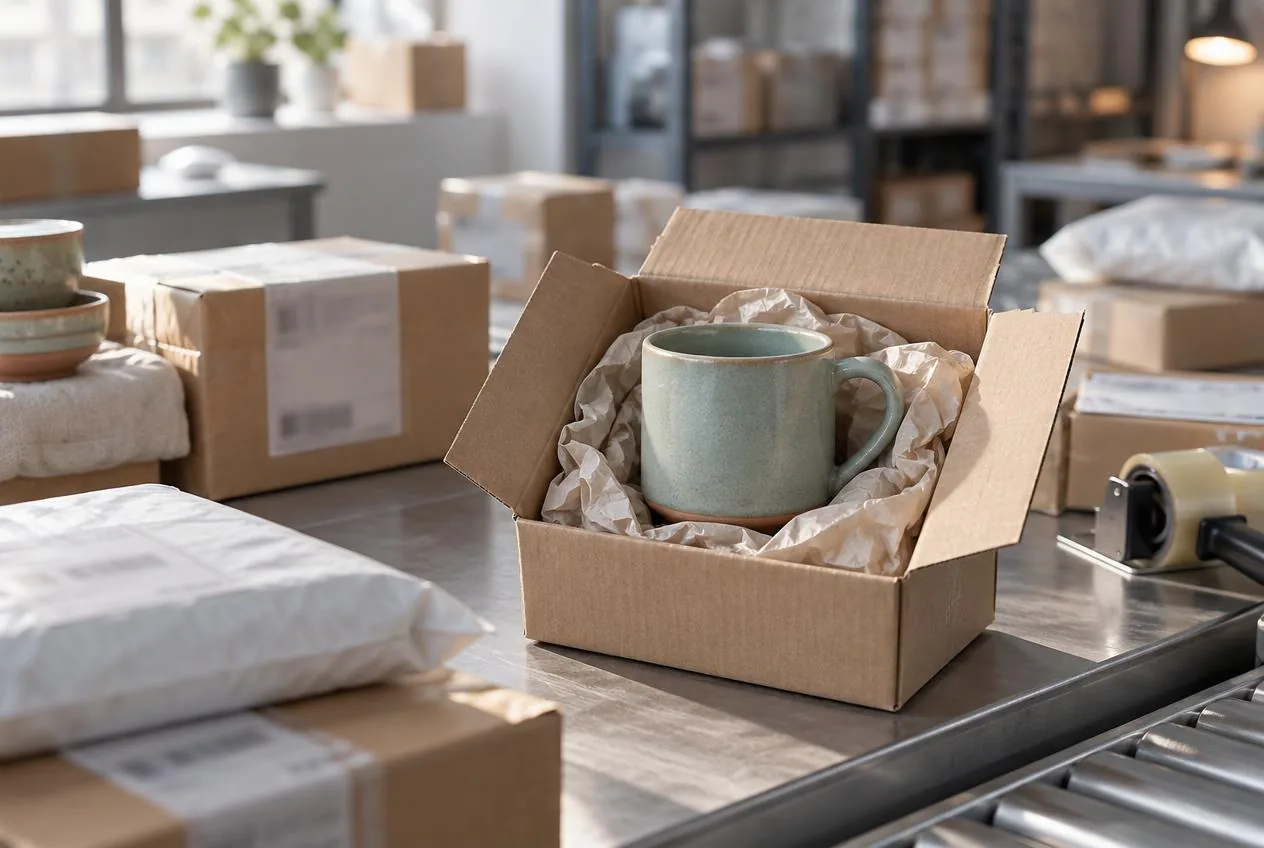
Every properly packed ceramic parcel has three working layers plus two supporting lines. The item layer wraps each piece individually in honeycomb paper or bubble wrap, so no two ceramic surfaces ever meet. The suspension layer — air-column cushioning is the workhorse — holds the wrapped pieces away from each other and from the carton walls, so shock lands on air, not on rims. The outer layer is a five-ply corrugated carton, sized so nothing shifts and sealed so it stays closed. Around them sit the supporting lines: void fill for odd geometries, and the tape and label whose cost is trivial but whose failure (the H-taping pattern skipped, the label on a seam) undoes the other three layers.
None of this is exotic. The cost question is not whether these layers exist but how consistently a packing line applies them at volume — which is why the packaging spec belongs in the SKU documentation with photographs, and why the packed parcel should be part of your golden sample approval.
What actually drives cost per parcel
- Carton size and weight — both the material cost of the box and, separately, the freight it generates. An oversized carton pays twice: more corrugate and more volumetric weight.
- Number of pieces — each piece needs its own wrap and its own separation; packaging cost scales with piece count faster than with value.
- Layer count — double-wrapping fragile rims or adding a second cushioning layer adds pennies per piece that compound across a 500-piece MOQ.
- Printed elements — your thank-you card, care instructions and branded tape are cheap per unit at volume but change the cash-out timing, since they are printed before the first sale.
- Labor seconds — a spec with photos packs faster than a spec with prose; at scale, seconds per parcel are a real line.
Cost tiers by order type
The table below shows the illustrative packaging stack we use across our dropshipping articles, now isolated on its own line. The numbers are illustrative, not quotations — but the ratio pattern is the point.
| Order type | Illustrative goods cost | Illustrative packaging cost | Packaging as % of goods |
|---|---|---|---|
| Single mug, wrapped and suspended | $1.50 | $0.60 | 40% |
| Four-mug bundle, one carton | $6.00 | $1.80 | 30% |
| 16-piece dinnerware set, one carton | $16.00 | $2.40 | 15% |
Read it as a scaling law: packaging cost rises with piece count but falls as a share of order value, because wrapping is per-piece while the carton, the label and the labor amortize across the parcel. This is one more reason sets outperform singles in ceramics — the parcel's fixed packaging overhead spreads across more value. A single mug paying 40% of its goods cost in packaging is not being packed badly; it is paying the minimum cost of caring about a small parcel.
The trade-off: packaging spend against the 5–8% world
Industry and insurer estimates put damage for fragile goods without professional packing at roughly 5–8% of units, and among returns caused by packaging, about 34% trace to transit damage. The trade-off math compares a packaging upgrade against the losses it prevents. One illustrative pass with a mug parcel: suppose the base pack costs $0.60 and an upgraded suspension layer adds $0.30, and suppose — as an assumption, not a claim — that the upgrade cuts parcel damage from 7% to 3%. Per 100 orders, the upgrade costs $30.00 and prevents four damage events. Each prevented event saves the full landed parcel — in our mug stack, roughly $9.80 — plus the resend freight and service time, call it $13–14 all-in per event. Four events saved is about $54 against $30 spent: the upgrade pays for itself with room to spare, and that is before counting the reviews that never happened.
Packaging is the only cost line in ceramics where spending more reliably reduces other cost lines. Freight spend does not reduce duty; packaging spend does reduce damage, resends and refunds.
The discipline is to run this arithmetic on your own numbers quarterly: measured damage rate against the reserve you priced, upgrade cost against events prevented. Where the gap is positive and stable, you have found cheap margin.
When the parcel becomes a pallet or a platform inbound
Two contexts upgrade the packaging conversation. Platform warehouses — FBA being the canonical case — require each item individually packed and the set validated against a 125 cm drop test on faces, edges and corners; a set that fails the drop fails inbound, and the failure is discovered on your account, not the factory's. Bulk sea freight changes the unit of care from the parcel to the pallet: EPE corner protection on stacked cartons, and IPPC-fumigated wooden crating or plywood boxes for full loads, so the container's own handling chain never touches bare ceramics. The shipping standard we publish spells out both regimes because they are different disciplines sharing one goal.
Keeping the cost down without weakening the box
Standardization is the honest way to cut packaging cost. Keep carton sizes to as few dimensions as the catalog allows, so boxes, air columns and dividers are bought in depth and packing lines build muscle memory. Fix the spec per SKU with photographs and keep it versioned — a silent spec change is how a damage spike arrives unexplained. Reuse the same packed-carton golden sample across reorders, and photograph one packed parcel per production run as dispatched evidence. None of these measures thin the protection; they remove the randomness that makes protection expensive.
If you want packaging costed as its own line in a quotation — layers named, drop standard stated, damage reserve shown — request a quote and we will structure it that way. The dropshipping operations hub shows how the packaging line fits the full per-order stack.
Frequently asked questions
How much should protective packaging add to a ceramic order's cost?+
Illustratively, expect packaging to run a meaningful share of goods cost on small parcels — on the order of tens of percent for a single mug — and fall as a percentage as sets spread the carton and labor across more pieces. The exact number matters less than treating it as a permanent cost line with its own spec, not a discretionary trim.
Is air-column cushioning worth it over simple bubble wrap?+
They do different jobs. Bubble or honeycomb wrap protects each piece's surface; air columns suspend the load so shock never reaches the pieces. Serious ceramic parcels use both, and the drop-test evidence for platform inbound assumes the full combination rather than one layer alone.
Can I ask my supplier to use less packaging to cut freight weight?+
You can optimize, not thin: right-sizing cartons cuts both corrugate and volumetric weight with no loss of protection, while removing wrap or suspension layers converts a certain small cost into a probable large one — a damaged parcel costs the goods, packaging, freight and duty together. Optimize dimensions; keep the layers.
What packaging does FBA inbound require for ceramics?+
Each item individually packed, with the set able to survive a 125 cm drop test on faces, edges and corners. Plan for that standard from the first sample round, because retrofitting packaging after a product is listed is slower and costlier than designing the carton alongside the product.