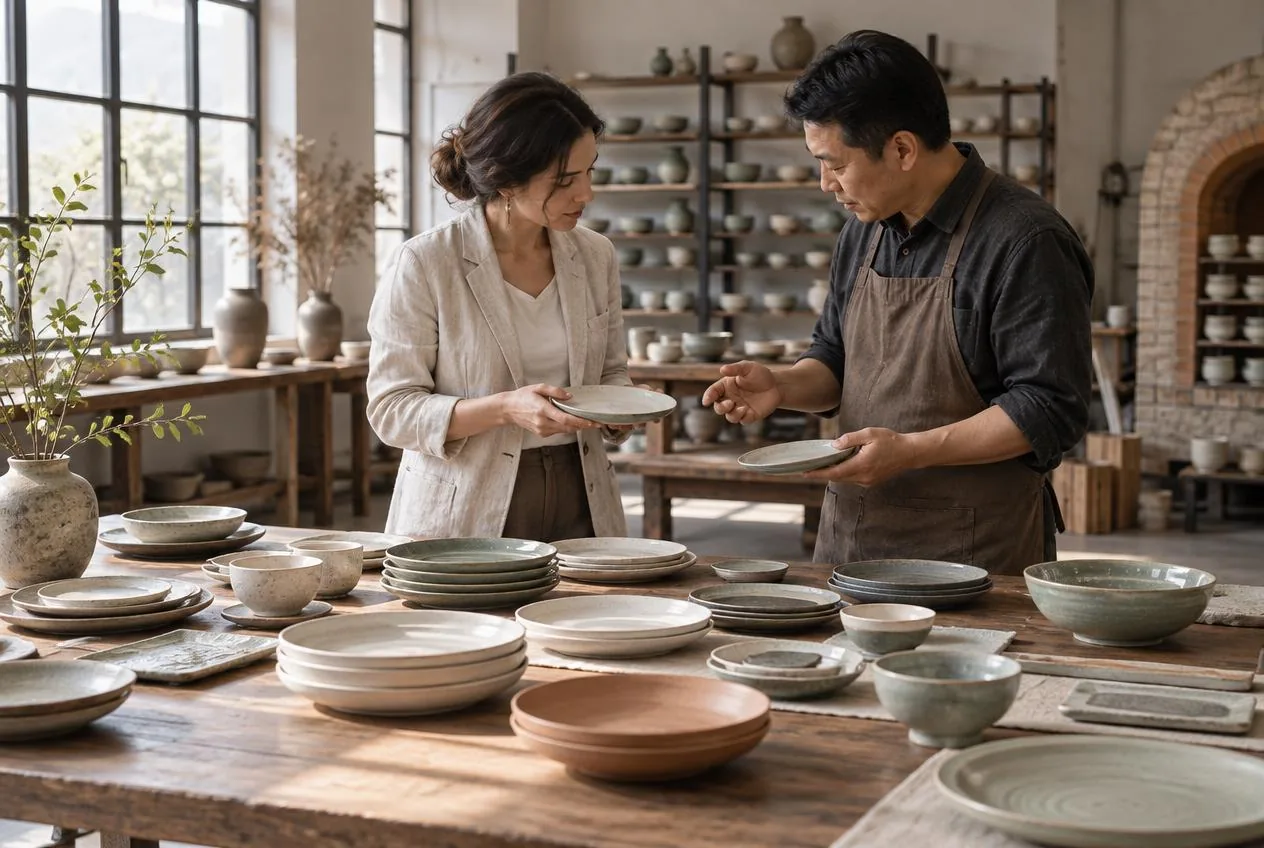
"China ceramics" hides more variation than most buyers expect: several major belts, different cost structures and different definitions of quality. This guide compares Chaozhou, Jingdezhen, Dehua and Liling on what each produces best, so your shortlist matches the program you are actually buying. It is for importers, brand owners and hospitality purchasers deciding where to place production.
Four belts, four different answers
The clusters grew around different customers. Volume retail pushed Chaozhou toward daily-use porcelain at scale; imperial and art heritage shaped Jingdezhen; export craftware built Dehua; and a decorated-ware tradition gave Liling its underglaze specialty. None of these regions is monocultural, but pricing the same specification in two clusters usually returns meaningfully different quotations, and the difference is explainable if you know what each belt is optimizing for.
The comparison matters at the moment of shortlisting, because a cluster chosen for the wrong reason is expensive to leave. Molds, glaze matching and decoration screens are all sunk into the first producing site that runs a custom program, and moving a line mid-program means re-sampling from zero. Deciding where production should sit, before tooling is commissioned, is the last low-regret decision a ceramics program offers, and it is worth an afternoon with the numbers below.
Chaozhou: volume daily-use porcelain
Chaozhou is the largest daily-use ceramics production region in China, with annual daily-use ceramic sales estimated at about 30% of the global total. In 2024 the city's ceramics exports reached RMB 11.26 billion, up 21% and crossing the ten-billion mark for the first time. For buyers this is the belt of broad catalogs, deep stock programs and competitive pricing on mainstream dinnerware; it is where a typical 500-piece stock order is easiest to place and fastest to repeat. The trade-off is differentiation: the same white coupe plate exists in a hundred showrooms, so brand distance has to come from decoration, packaging or glaze work rather than from the blank itself.
Jingdezhen: high-end, art and bone china
Jingdezhen's ceramic industrial output exceeded RMB 93 billion in 2024, up 9%, and the city holds more than 60% of China's art ceramics market. It remains the reference address for high-fired fine porcelain and bone china: bone china fires around 1380°C, and the fine white porcelain bodies across the region typically fire in the 1280–1380°C window. Programs that need thin rims, artist collaboration, reactive color work or gift-grade finish tend to price best here. Expect longer sampling cycles and firmer MOQs than the volume belts, because much of the capacity is organized in studios and specialized workshops rather than single large lines.
Dehua: craft white porcelain and export craftware
Dehua's cluster reached RMB 66.3 billion in scale in 2024, up 15%, across more than 4,500 enterprises, and the county accounts for close to 80% of China's craft-ceramic exports. Its signature is white porcelain with strong sculpting and a gift orientation, which translates directly into teaware, serving pieces and seasonal programs. For buyers of blank-driven or sculptural product, Dehua offers the widest bench of workshops that live off export craftware year round.
Liling: the underglaze color tradition
Liling's cluster output exceeds RMB 80 billion, and the city is the traditional home of underglaze five-color decoration. That matters commercially because underglaze color sits beneath the glaze surface, so decoration adds no exposed color layers: lead and cadmium migration risk is structurally lower, which lines up directly with the FDA 21 CFR 109.16 limits and EC 84/500/EEC testing that hospitality and retail buyers face. Compliance-sensitive programs increasingly specify underglaze for exactly this reason, independent of aesthetics.
| Your program | Cluster to price first | Why |
|---|---|---|
| Stock dinnerware sets for ecommerce | Chaozhou | Broad catalogs, stock programs at a typical 500-piece MOQ, fast reorders |
| High-end porcelain or bone china line | Jingdezhen | Thin-wall and high-fire capability, art resources, gift-grade finish |
| Sculptural white teaware and gifts | Dehua | Craft white porcelain depth and year-round export craftware focus |
| Compliance-sensitive decorated lines | Liling | Underglaze decoration with structurally lower migration risk |
| Full-range program across price tiers | Two clusters at least | The same spec priced in two belts exposes the real cost structure |
Run one specification across clusters
The comparison only works if every cluster quotes the same object. Fix the specification first: body type, glaze, decoration method, dimensions in mm and capacities in ml, packaging. Then send identical briefs to shortlisted factories in two or three belts and compare the answers line by line. Where quotes diverge, ask what is driving the gap: kiln type, body preparation, decoration subcontracting, or simply distance from the cluster's specialty. Custom programs add mold and glaze development on top, which the OEM program page covers in detail.
Sampling closes the argument. Quotation sheets rank cost; golden samples rank reality. Whichever cluster wins, keep the second-best quotation warm, because kiln schedules slip and peak seasons compress, and a second source in a different belt protects you better than a second source on the same street. Start the conversation through the sourcing desk, or review finished references across tea sets and dinnerware so the discussion starts from physical pieces rather than renderings.
Frequently asked questions
Is Chaozhou always the lowest-cost option?
For mainstream daily-use porcelain at volume, usually yes, and the 30% global sales share reflects that scale. The gap narrows or reverses once a program needs thin walls, sculptural forms or specialty glazes, where Jingdezhen or Dehua workshops are simply closer to the required capability.
Can one supplier produce across several clusters?
Some groups operate across belts, and trading companies consolidate anyway. What matters is knowing where each SKU physically fires, because kiln logging, glaze control and decoration quality are checked at the producing site, not at the group headquarters.
Which cluster should I choose for underglaze decoration?
Liling is the traditional underglaze five-color region and a natural first stop. Underglaze lines exist elsewhere too, so the deciding document is a third-party migration test report against your destination standard, not the cluster name on the business license.