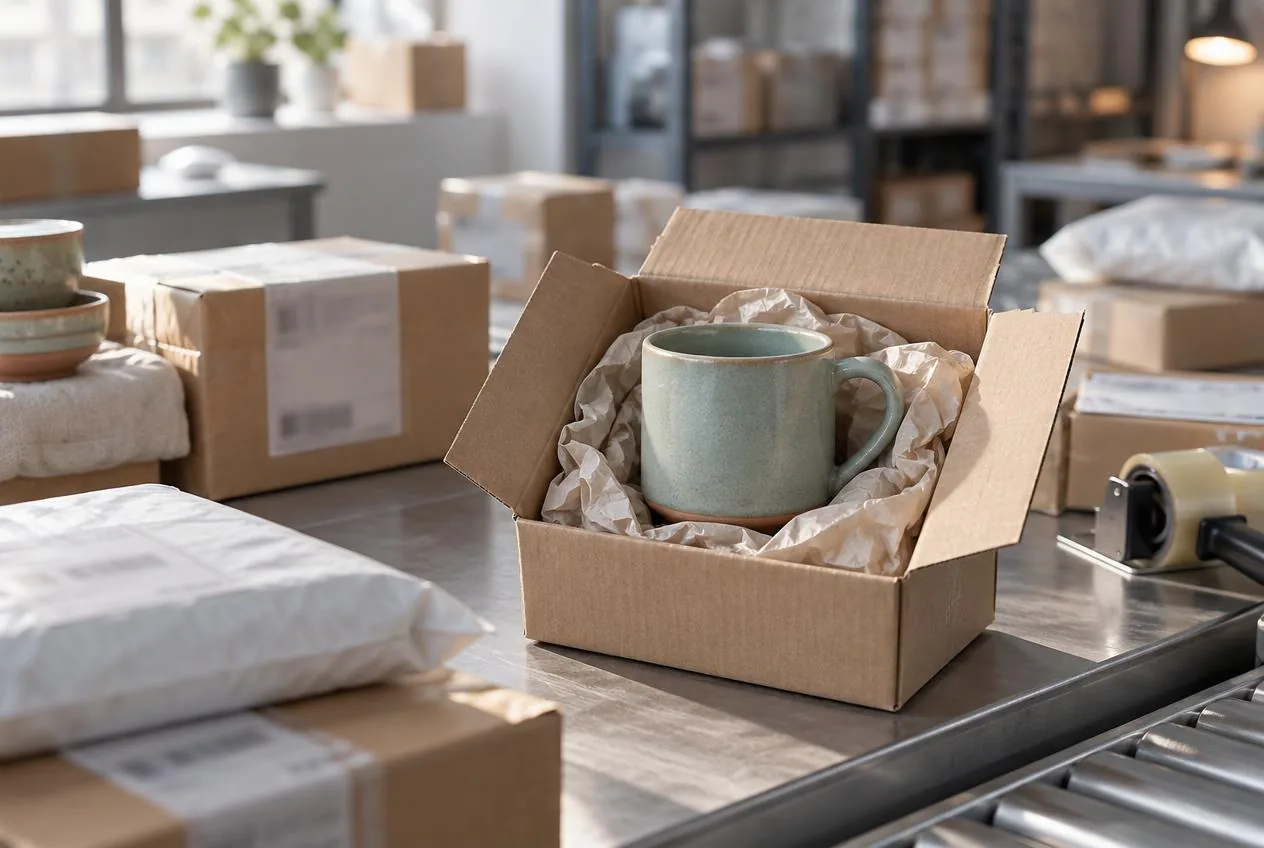
Most advice on dropshipping fragile products starts with product selection and treats damage as an afterthought. That order is backwards for ceramics, where breakage is not an occasional annoyance but a standing cost that either gets priced in or eats the margin silently. This article lays out a breakage-first model: you quantify the loss rate, design the packaging and replacement policy first, and only then decide what you can profitably sell.
Start from the loss rate, not the product price
Industry and insurer estimates put damage for fragile goods shipped without professional packing at roughly 5–8% of units. Two properties of that number matter more than its size. First, it is a rate on units, not on value — but the loss per event is the full landed cost of the parcel: goods, packaging, freight and duty all burn together. Second, the rate is not fixed; it is mostly a function of packing quality and handling chain, which means it is one of the few cost levers you directly control.
The downstream evidence agrees: among returns caused by packaging, about 34% trace to damage in transit. In soft goods, a rough parcel is a bad review. In ceramics, it is a bad review plus a full refund plus a replacement shipment, if you run a service-oriented store.
The breakage-first model in five steps
- Fix the packaging standard before the price. Per-piece honeycomb or bubble wrap, air-column cushioning, five-ply outer cartons as the baseline; individual packing validated to a 125 cm drop (face, edge, corner) for platform inbound.
- Quantify the reserve. Take your landed cost per order and multiply by a stated damage assumption inside the 5–8% band, adjusted for how well your packing and lane perform. That number becomes a cost line, not a surprise.
- Price from the stack. Goods, packaging, freight, duty, reserve — then apply margin. Never price from the product cost alone and hope.
- Write the replacement policy before launch. Claim window, photo evidence, replacement versus refund, and who pays the resend freight.
- Track the actual rate and re-price quarterly. If your measured damage runs well under the reserve, you have margin to reinvest; if it runs over, fix packing or change the lane before touching the ad budget.
What one damaged parcel really costs
The reason breakage deserves its own model is asymmetry: one damaged order costs far more than the average order earns. Using an illustrative landed cost of $33.00 per 16-piece set — goods $16.00, packaging $2.40, air DDP freight $9.50, duty and brokerage $3.20, and a breakage reserve of $1.90 at roughly 6% — a single damaged parcel destroys the entire $33.00 stack, then adds a second freight leg for the replacement and your service time on top. To recover one $33.00 loss at a $12.00 contribution margin per good order, roughly three extra good orders exist just to pay for the one broken one.
Run that arithmetic against the 5–8% band and the design conclusion is immediate: every fraction of a point you shave off the damage rate is worth more than the same fraction shaved off product cost, because the loss carries the whole stack with it. Prevention beats refund policy. This is the arithmetic we apply when we quote ceramics with the breakage reserve shown as its own line.
Pricing with a reserve, honestly
| Element | Approach | Discipline |
|---|---|---|
| Damage assumption | A stated % inside the 5–8% band, set per lane and packing spec | Written into the costing sheet, reviewed quarterly |
| Reserve in price | Folded into the retail price as a cost line | Not marketed as "insurance"; not refunded when unused |
| Actuals | Damage per 100 orders, tracked weekly | Under assumption: bank the gap. Over: fix packing, not price |
| Resend freight | Named in the replacement clause | Supplier-funded on packed-to-spec damage; otherwise yours |
The packaging standard that moves the number
The 5–8% baseline describes fragile goods without professional packing — it is not destiny. The stack that reliably beats it is unglamorous and specific: every piece wrapped individually in honeycomb paper or bubble wrap, suspended in air-column cushioning so pieces cannot contact each other or the carton wall, closed in a five-ply corrugated outer box sized so nothing shifts. For parcels headed into platform warehouses, the standard tightens further: each item packed individually and the set validated against a 125 cm drop test on faces, edges and corners.
Two disciplines keep the standard real at volume. First, packing instructions travel with the SKU — diagrams, not prose — so a new packing-line operator produces the same parcel as the one you approved. Second, the golden sample includes a packed parcel: you approve the box, not just the mug.
Design the replacement policy as carefully as the box
- A stated claim window — long enough to cover delivery-day discoveries, short enough to deter abuse.
- Photo evidence of the outer carton and the damaged piece; this is also your data on where damage enters the chain.
- Replacement-first for damage, refund for refusal — replacements preserve the sale and cost less than refunds once freight is shared.
- A spare-pieces program for sets: keeping a small spare ratio per MOQ lets you replace one side plate from stock instead of resending a full set.
- No public "any damage, full refund, no questions" promises you have not costed — generosity without a reserve line is how fragile-product stores die quietly.
Measure damage per 100 orders weekly, not monthly — a packing-line change or a new courier lane shows up in weeks. When you outgrow parcel shipping, the same discipline carries into bulk moves: see how we stage and consolidate orders for international shipping once velocity justifies it.
Metrics that tell you the model is working
Three numbers cover it. Damage rate per 100 orders, against your stated assumption inside the 5–8% band. Claim cycle time, from customer photo to replacement dispatched, because service speed determines whether a damage event costs you a review or earns a loyal customer. And reserve variance — the gap between the reserve you priced and the losses you actually took — which is the most honest single measure of whether your packaging investment is paying for itself.
If you are building a fragile-product store and want the reserve modeled on real lanes rather than guessed, request a quote with your target markets and SKU list.
Frequently asked questions
What damage rate should I plan for when costing ceramics?+
Start inside the industry's 5–8% band for fragile goods without professional packing, then adjust with evidence. With per-piece wrapping, air-column cushioning and five-ply cartons, an operation should land well under the top of that band — and your measured rate, not the industry estimate, belongs in the costing sheet after the first quarter.
Is it cheaper to refund damaged orders or replace them?+
Replacement is usually cheaper and better for the brand. The goods are sunk either way; a replacement reuses the relationship and often shares freight economics, while a refund ends the sale. The exception is when replacement transit is slow — then a fast refund plus a discount re-save protects the review score.
Does better packaging really pay for itself?+
Work through one event: a damaged parcel costs the full landed stack — goods, packaging, freight and duty — plus a resend and service time. Because each loss carries the whole stack, a packaging upgrade that prevents even one or two losses per hundred orders typically covers its own per-parcel cost several times over. Price it as a trade-off with your own numbers, not as a faith decision.
Should the supplier or the store carry the breakage reserve?+
Split it by control. The supplier carries damage that happens despite packed-to-spec dispatch, funded through a replacement clause; the store carries everything downstream of the courier scan. That split aligns each party's incentive with what it actually controls — and it is the structure we use in dropshipping SLAs.