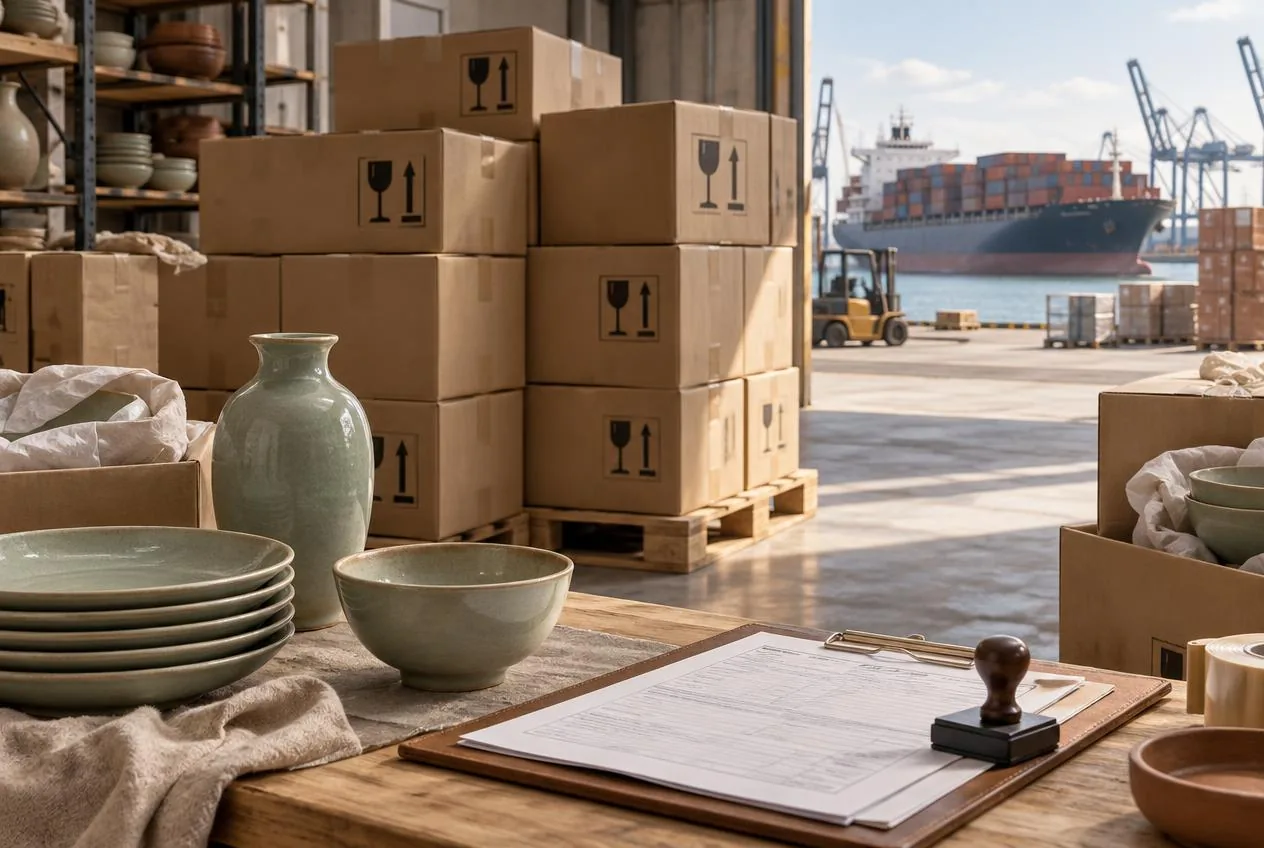
Since 7 February 2026, the EU's 79.0 percent anti-dumping duty has made China-direct ceramics structurally expensive, and buyers are re-sorting their options: keep importing and pay, shift origin, restock through EU warehouses, or change category. Each route carries a different cost structure, lead-time profile and compliance load — and at least one popular shortcut is a legal trap. This guide compares the realistic routes honestly, including the ones that do not survive contact with customs law.
What the 79% rate rules out
Start with the arithmetic that ended an era. On an illustrative CIF value of EUR 10,000, the pre-February duty structure cost between EUR 1,310 and EUR 3,610 depending on the exporter's rate. From 7 February 2026, the same shipment carries EUR 7,900 in anti-dumping duty under (EU) 2026/274, before national import VAT and clearance fees. A direct-from-China DDP model priced on the old rates loses competitiveness by a margin no negotiation on the goods can recover — and shifting to DAP terms merely moves the payment from supplier to buyer without changing the economics.
The realistic option set
| Option | Duty treatment | Economics | Operational load |
|---|---|---|---|
| Keep China, import DAP and pay 79.0% | Duty paid by you at entry | Transparent but expensive; viable only where the product cannot be replaced | Low |
| EU-warehouse stock programs | Duty embedded once in stock cost | Smooth per-order fulfillment; holding costs and slower cash conversion | Medium |
| Non-Chinese origin production | Duty depends on the goods' origin | Variable by country and factory; requires requalification | High |
| Adjacent materials, e.g. glass serveware | Outside the ceramics anti-dumping measure | Different product identity and margin structure | Medium-high — a new compliance lane |
| EU-based production | No China anti-dumping duty | Different price band and capacity profile | High |
No option reproduces the pre-2026 world. The exercise is to find the least-bad fit for your assortment, velocity and margin floor — which starts with knowing your own numbers well enough to compare them.
Two practical constraints cut across every route. Lead time: a warehouse program delivers from inside the EU in days, while any new origin requires qualification, sampling and first production before a single sellable unit ships — count in months, and treat the transition period as a stocking problem, not a procurement footnote. Volume: requalifying an origin usually means committing to the new supplier's program minimums, and ceramics factories think in production runs, not sample quantities. Buyers who map both constraints against their cash cycle before choosing a route avoid the classic failure — switching origins mid-season and running out of stock during the gap.
Origin is a legal fact, not a shipping route
The most common bad idea after a duty jump is transshipment: shipping Chinese goods through a third country and re-papering them as local products. Customs origin is determined by where goods are produced and substantially transformed, not by where vessels call or invoices are issued. Relabeled goods remain Chinese-origin, and their detection is not exotic — customs authorities reconcile production footprints, and penalties include back-duty, fines and seizure. A sourcing strategy that depends on not being audited is not a strategy. If a third country appears in your supply chain, it should be because manufacturing moved there, with the tooling, inputs and value-added to prove it.
What other markets' measures tell you
The duty map moves everywhere, not only in Europe. Mexico's anti-dumping measures on Chinese ceramic tableware were terminated in February 2026 following a court ruling, while Brazil maintained specific per-kilogram duties after its second expiry review. Two lessons follow for EU-facing buyers. First, "alternative markets" are not duty-free by definition — each destination carries its own measures that must be verified per product and per moment. Second, remed maps shift on the scale of years, so origin decisions made in 2026 deserve an annual review rather than a one-time migration.
A decision framework by buyer type
| Buyer type | Primary route | Rationale |
|---|---|---|
| Ecommerce brand | EU-warehouse stock, or DAP with duty-modeled pricing | Delivery speed and per-order economics dominate; duty transparency keeps retail pricing honest |
| Wholesale distributor | Multi-origin portfolio; qualify a non-Chinese line alongside existing suppliers | Margin defense across rate scenarios; customers increasingly ask for origin options |
| Hospitality program | Phased mix: EU stock for urgent phases, origin shift for rollout waves | Project timelines cannot wait for requalification, but multi-year programs justify it |
Whichever route you take, the food-contact compliance work does not change: EU imports still need Directive 84/500/EEC conformance and the CE documentation described on our compliance page, whatever the goods' origin.
Frequently asked questions
Can I just ship via a third country to avoid the duty?+
No. Goods that are only routed or relabeled through a third country remain Chinese-origin, and presenting them otherwise is customs evasion with penalties that include back-duty and seizure. Origin changes only when production substantially moves and transforms the goods there.
Will the 79% duty come back down?+
The measure is under legal challenge, with proceedings pending as of our September 2026 review, and trade-remedy measures evolve through periodic reviews. No outside observer can predict the outcome — plan on the current rate, and keep pricing clauses flexible.
Is glass serveware subject to the ceramics duty?+
The anti-dumping measure targets ceramic tableware and kitchenware from China; glass products are classified and measured separately. That makes glass an adjacent category worth evaluating — but verify its classification and any applicable measures per product before building a line on the assumption. The tariffs hub tracks the standing measures.
Comparing origin options is procurement work, not guesswork — send your assortment and target lanes, and request an options quote. For how the EU position sits beside the US and UK, see the Europe market page.