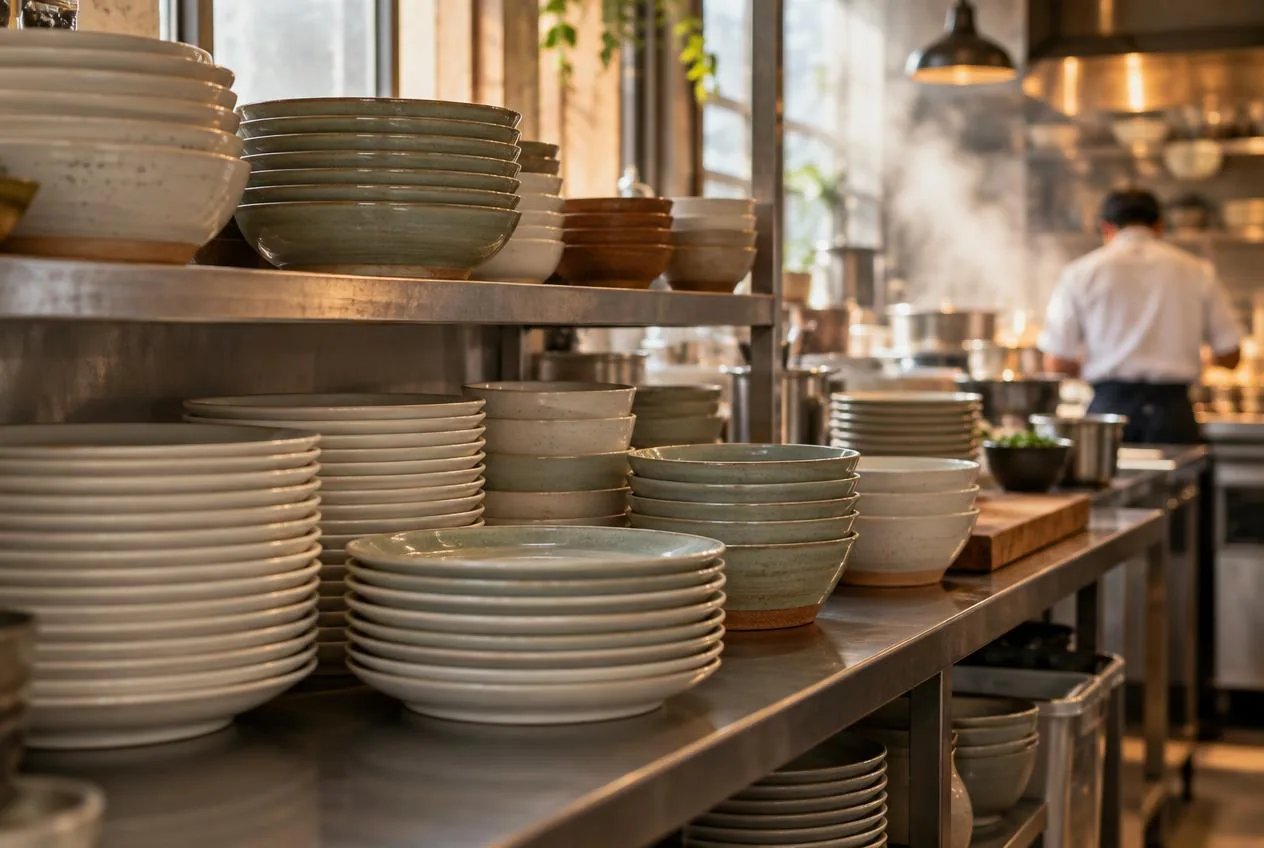
Fine dining plates must survive a pass they were never styled for: three in a waiter's hand, a rack in the dish area, a stack in storage. This article is for chefs, F&B directors and procurement at fine-dining rooms and hotel signature restaurants — where presentation leads, but where weight, rim width and decoration choices decide whether the program still looks right two years in.
The tension between photo and floor
Presentation ceramics are chosen twice: once by eye from a sample, and once by the floor that has to live with them. Wide-rimmed canvases photograph beautifully and eat storage. Featherweight porcelain signals refinement and chips on the first rail it meets. Dramatic glazes look extraordinary and vary from batch to batch. None of these are reasons to avoid ambitious ceramics — they are trade-offs to make deliberately, with the kitchen's real handling patterns on the table before the order is placed.
Weight: signal and servicing cost
Weight does two jobs at once. In the hand, a plate with presence — what the trade calls quality heft — signals substance before the first course lands; guests read it without knowing they are reading it. In the dish area, the same grams become freight, labor and rack load multiplied by every cycle of service. The resolution is material, not styling: fine porcelain fired in the 1280–1380℃ window delivers density and a clean ring at moderate thickness, so the plate reads substantial without importing the breakage risk of thin domestic bodies. Bone china, fired around 1380℃ with its characteristic translucency, sits at the elegant end of the scale — right for signature rooms where handling is controlled, wrong for banquet floors.
Rim width and usable plating area
Nominal diameter is not plating area. A wide-rimmed plate presents on a canvas far smaller than its number suggests — which is precisely its charm, and precisely its storage cost, since the full diameter rides along in every rack, shelf and stack. The professional approach is to specify both numbers, nominal diameter and usable well diameter in millimeters, and to check the wide formats against the rack compartments the room actually runs, because a plate that sits proud scuffs on every cycle. Deep, narrow-rimmed formats invert the trade-off: compact in storage, dramatic on the table, less canvas for the chef. Neither direction is wrong; what fails is buying one while measuring for the other.
Decoration that reads at the table
Fine-dining ceramics earn their keep at half a meter, not across the room. Underglaze blue line work, celadon tones, matte glazes and quiet reactive surfaces read as texture rather than pattern — and they carry a technical advantage beyond taste. Underglaze decoration is fired beneath the glaze, so it wears at the glaze's rate rather than the detergent's, and it carries structurally lower lead and cadmium migration risk for the compliance file. Metallic banding and on-glaze brights photograph beautifully and sit at the top of the wear list; they are legitimate choices for controlled-service rooms, provided the cost is paid knowingly. Whichever direction the design takes, compliance is by named standard — FDA 21 CFR 109.16, EC 84/500/EEC, LFGB — with third-party test reports available on request; see our compliance overview.
The pass-around test
- Carry three. The waiter test: three plates in one hand over a real pass distance; edges should not bite, and the weight should not climb the arm.
- Plate on them. A plating session with the actual menu: canvas size, well depth, color against the food, and how the rim frames each course.
- Rack them. Fit every format into the dish racks the room actually runs; proud plates fail slowly and visibly.
- Stack them. Storage reality: stack height without rim contact, per format, against the shelving the room actually has.
- Wash them. Two weeks of real cycles against a kept golden sample; check rims, feet and decoration under strong light.
Five checks, one afternoon of effort — and they convert a purchase driven by taste into one that survives the floor.
Specifying without killing the design
The specification language of fine dining is the same as any hospitality program, only weighed differently: presentation formats lead, durability lines still bind. Reinforced does not mean chunky — rim engineering lives inside profiles the guest never notices — and stackability lives in the recessed footring, invisible in service. Rooms that get this right buy ambitious ceramics once and keep them for years; rooms that buy from the photo alone buy them twice. See how presentation and service requirements combine on our hospitality program page, browse formats in the plates range, and bring the plating session's conclusions to a quotation request — samples prove design, but specifications prove repeatability.
Frequently asked questions
Do fine-dining plates need to be "hotel ware"?+
Reinforced engineering, yes; hotel styling, no. Rim and footring engineering are invisible in service, so a plate can carry banquet-grade durability while reading as a presentation canvas. The two decisions are separable, and separating them is the spec writer's job.
Is bone china too fragile for restaurants?+
It depends on handling. Bone china fires around 1380℃ and suits controlled-service rooms — tasting menus, signature dining — where pieces are carried and racked with care. For banquet volume, pool decks and high-turn floors, reinforced porcelain remains the duty-rated choice.
How do we match glaze across reorders?+
Retain golden samples and align top-ups with production runs; batch-aligned reorders limit visible variance. Matte and reactive glazes vary the most between batches, so those programs benefit most from writing batch-alignment into the reorder terms.
What diameter should we specify?+
Specify nominal diameter and usable well diameter in millimeters, then verify both against the menu and the dish racks. A diameter chosen from a product photo alone is the most common way fine-dining programs end up with plates that do not fit their own racks.