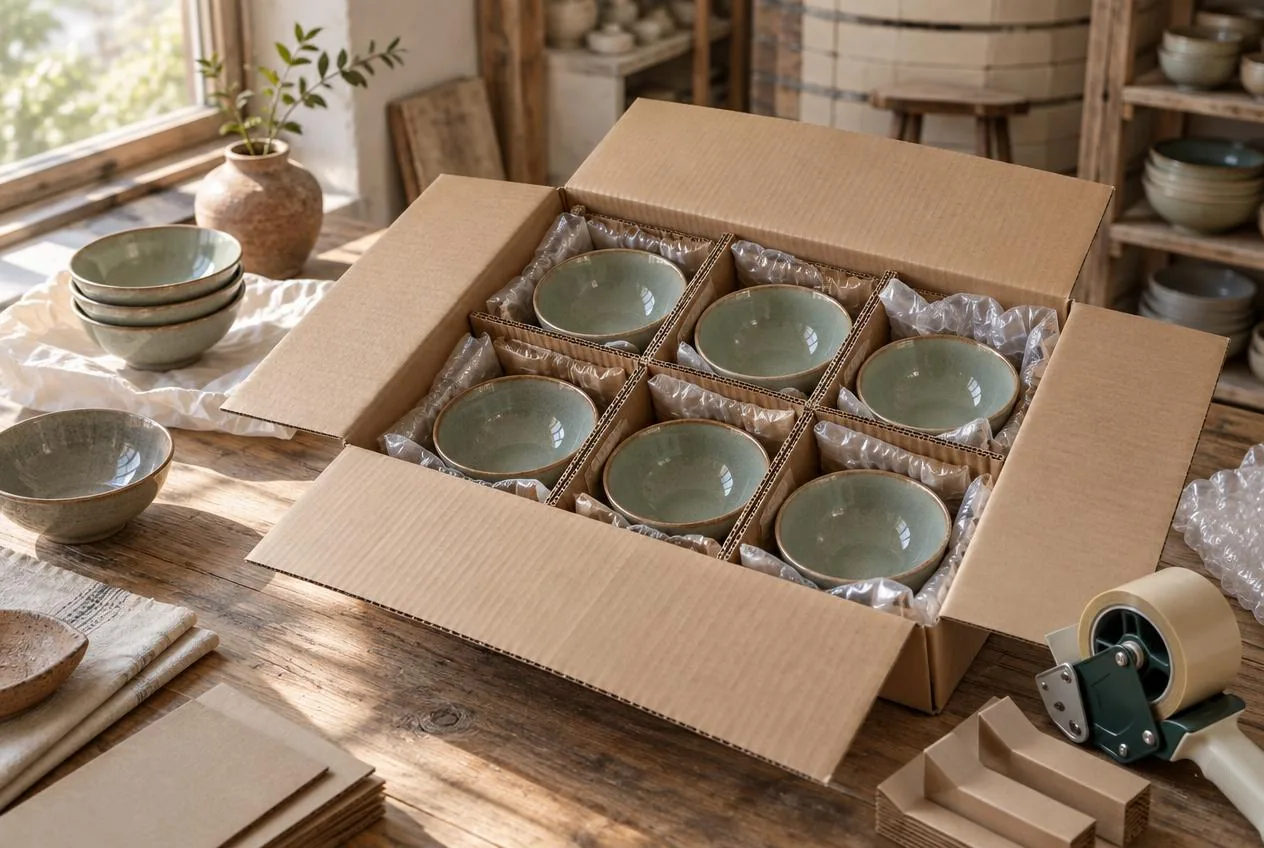
Most ceramic breakage is decided weeks before the container leaves the factory — at the packing bench, not on the truck. Industry and insurer figures put breakage for fragile goods shipped without professional packaging at roughly 5–8 percent, and 34 percent of packaging-related returns trace back to damage in transit. This guide sets out the packing standards that hold up on parcel, platform-inbound and palletized sea lanes, so you can audit any supplier's pack before your order ships.
Why ceramic packaging fails
Ceramics fail in transit for three mechanical reasons: shock (a drop or an impact that the cushioning cannot absorb), vibration (hours of road or rail movement that grind surfaces against each other), and compression (cartons stacked in a container or a delivery van crushing the weakest box in the stack). A packing system that handles one of these but not the others still produces claims. The industry baseline is worth internalizing: without professional packaging, roughly 5–8 percent of fragile goods arrive damaged according to industry and insurer estimates — and since packaging-related returns are dominated by breakage (34 percent of them), the packing bench is where your margin is protected.
Packaging is not a cost line to minimize. It is the least expensive insurance you will ever buy on a ceramics order.
The four-layer packing system
Professional ceramic export packing works in layers, each with a distinct job. When you review a supplier's pack, check that all four exist — a single layer doing double duty is where failures start.
| Layer | Material (typical) | Job it does |
|---|---|---|
| 1. Piece wrap | Honeycomb kraft wrap or bubble wrap, taped shut | Stops piece-on-piece contact; protects rims, handles and feet |
| 2. Cushioning | Inflatable air column bags molded to the piece | Absorbs shock and isolates each item inside the carton |
| 3. Inner carton | Five-layer reinforced corrugated box | Structural shell against compression and repeated handling |
| 4. Outer unit | Master carton, pallet or wooden crate | Unitizes the order for the lane: parcel, platform inbound or sea |
Two details separate a serious pack from a casual one. First, nothing moves: when you shake a sealed inner carton, you should hear nothing shift inside. Second, no hard contact: two unwrapped ceramic surfaces should never touch anywhere in the system, including the lid area and the base pads.
Match the pack to the lane
The same mug needs a different outer system depending on how it travels. Overspecifying wastes freight budget; underspecifying converts savings into claims.
| Lane | Outer system (typical) | Standard to demand |
|---|---|---|
| Parcel / small parcel express | Piece wrap + air column bags + five-layer carton, one SKU per box | Empty space filled; no piece-to-piece contact anywhere |
| FBA / platform inbound | Each unit individually packaged; set passes a 125 cm drop test on face, edge and corner | Three-sided drop compliance per the platform's own standard |
| Sea freight, palletized | EPE corner protectors + IPPC-fumigated wooden crating or fumigation-free plywood boxes | ISPM 15 marking on any solid wood in the load |
The FBA row deserves emphasis: platforms re-handle inbound cartons mechanically, and their packaging requirements exist because of it. If you sell through marketplaces, write the 125 cm drop requirement into the purchase order, not just the email thread. Our global shipping page lists the packing standards we commit to per lane.
Wood, pallets and the IPPC rule
Sea-bound ceramics travel on wood, and wood is regulated. Any solid wood crate, brace or pallet in an international shipment must be heat-treated or fumigated and marked under the IPPC (ISPM 15) regime, or customs at destination can hold, treat or re-export the load — a delay measured in weeks. The two clean answers are marked, fumigated wooden crating or fumigation-free plywood boxes, which are exempt from the treatment requirement. Pair either with EPE (expanded polyethylene) corner protectors, because pallet loads fail at the corners first: forklift contact, clamp trucks and adjacent loads all attack the edges of the stack.
Ask your supplier to photograph the crating before the container closes — IPPC marks, corner protection and load bracing, one frame each. Three photos at dispatch are worth more in a claim than three pages of argument afterwards.
A pre-dispatch packing checklist
- Every piece individually wrapped; no ceramic-to-ceramic contact anywhere in the carton.
- Air column or equivalent cushioning fills the void; a sealed carton passes the shake test silently.
- Inner boxes are five-layer reinforced corrugated, not standard single-wall stock.
- Master cartons are seam-taped and labeled fragile on two adjacent faces, with orientation arrows.
- Platform-bound units are individually retail-packaged and packed to pass the 125 cm face/edge/corner drop sequence.
- Palletized loads carry EPE corner protection and IPPC-marked wood or plywood crates only.
- Carton stacking height inside the container respects the crush strength of the bottom row.
- Photos of the finished pack are on file before the truck departs.
Run this list against a sample packed carton from your current supplier. Anything you cannot verify from photos is a finding, not a detail — the same discipline used for pre-shipment inspection on our quality and compliance side applies to the packing bench.
What breakage actually costs
Run one illustrative scenario to price the risk. A 500-piece mug order shipped with casual packing at the low end of the industry breakage band — 5 percent — loses 25 pieces. Replace them and you pay the goods value a second time on a quarter of the order, plus freight, plus the customer conversation. Professional packing with air column bags and five-layer cartons typically adds a few percent to the goods value; one avoided breakage event across a few orders pays the difference. This arithmetic is illustrative, but the direction is not: packaging spend is priced against a loss rate that is already published, not against a hypothetical.
Packing standards are one half of the equation; the freight terms that decide who bears breakage are the other. When you request a quote, ask for the packing specification and the loss-handling clause together, because neither is meaningful alone.
Frequently asked questions
How much does professional ceramic export packing add to cost?+
It varies by piece geometry and lane, so treat any single figure skeptically. The comparison that matters is against the published loss baseline: roughly 5–8 percent breakage without professional packaging, with each damaged piece costing its goods value plus freight plus handling to replace. Price the pack against that band, not against zero.
What is the 125 cm drop test?+
It is the platform inbound standard for fragile goods: the packaged set must survive a drop from 125 cm onto its face, edge and corner — three drops in total. It approximates the mechanical handling your cartons receive between the factory and the fulfillment center shelf.
Do plywood crates need IPPC fumigation?+
Manufactured plywood is exempt from ISPM 15 treatment because the manufacturing process already eliminates pests. Solid wood crates, braces and conventional pallets are not exempt — they must carry IPPC treatment marks, or the shipment risks being held at destination.
Can I just double-box everything instead?+
Double-boxing helps only if the void between boxes is cushioned and the inner box has no piece-to-piece contact. Two boxes with loose ceramics inside behave like one box with extra cardboard. The layered system — wrap, cushion, carton, outer — is the standard for a reason.