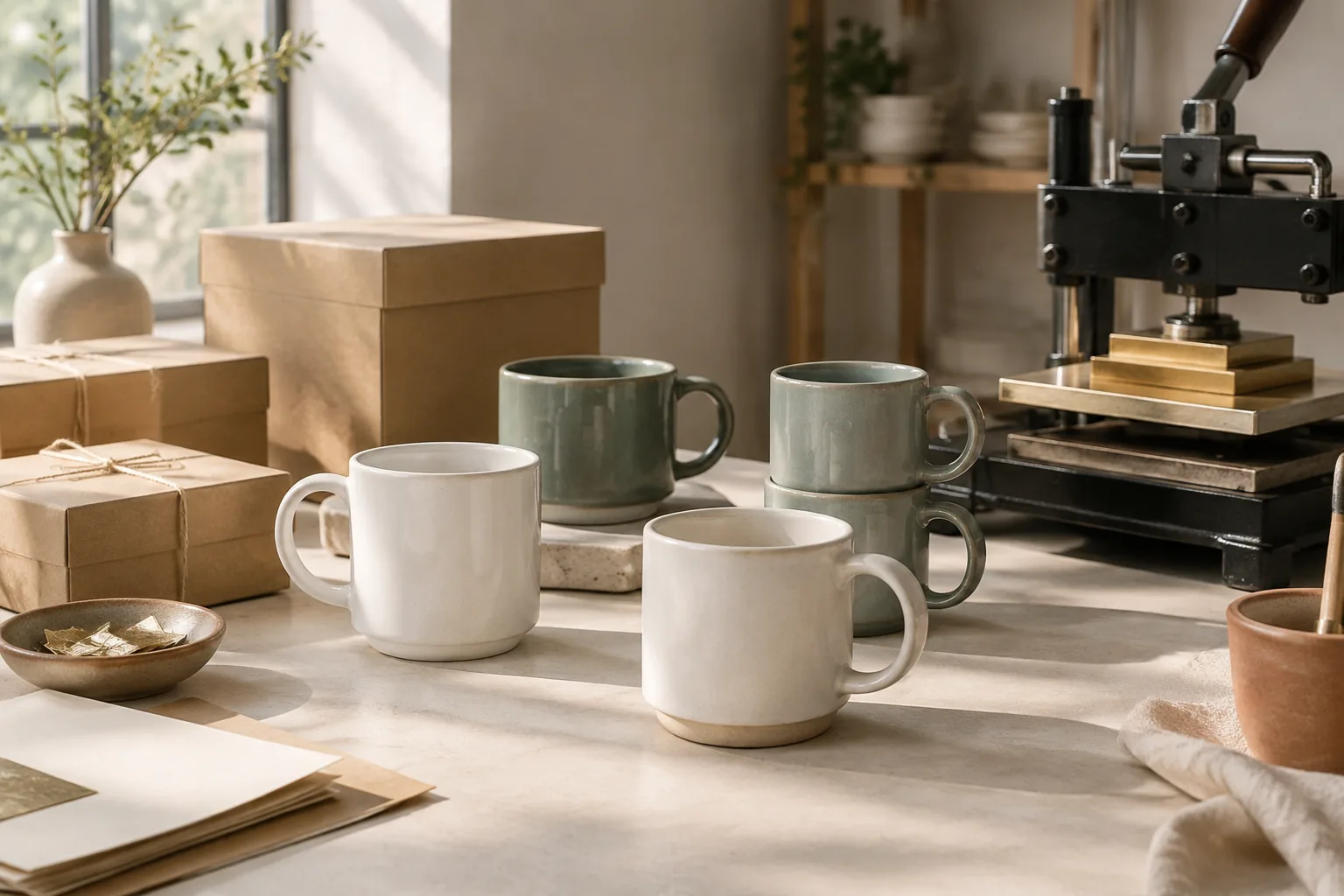
Ask five suppliers for a custom ceramic mug and you will hear minimums from five hundred to five thousand pieces — and the honest answer sits in the middle: 1000–3000 pieces per SKU is the typical range for genuine customization. This article explains where that number physically comes from, what moves a quote within the range, and which "low MOQ" offers are real and which are quietly recovering the difference elsewhere.
Buyers often read custom MOQs as stubbornness, a tax on small brands, or a number there to be negotiated down by a good enough story. None of that is true, and treating it that way wastes leverage on the wrong lines. A custom minimum is the arithmetic of a kiln workshop committing shared resources to a product that only one customer sells. Understanding the arithmetic is what turns a stalemate into a smaller, smarter first order.
The physics behind the number
Customization consumes factory resources before a single saleable piece exists, and each consumed resource has a volume below which the workshop cannot run it rationally:
- Kiln loading. A kiln car or firing batch holds thousands of pieces of one profile. Producing far below a fill level means firing partly empty space at full cost — the loss lands somewhere, and honest quotes put it in the MOQ instead of hiding it in the unit price.
- Glaze batches. A custom glaze is mixed, tested and recorded as a batch. Small, sporadic batches produce color drift and waste lab capacity — the reason custom colorways carry higher minimums than stock glazes.
- Tooling and screens. Mold sets wear and need replacement planning; each decal color is a screen. These are setup costs that reorders amortize — the first order carries them.
- Line changeover. Switching a shaping line between profiles consumes hours of skilled labor. A longer run per SKU spreads one changeover over more pieces.
This is also why stock programs run at a typical 500 pieces per SKU: the form, glaze and decoration already exist in continuous production, so the factory amortizes nothing on your behalf.
What moves a program within the 1000–3000 range
| Factor | Pushes the minimum down | Pushes the minimum up |
|---|---|---|
| Number of distinct shapes | One hero form concentrates volume | A set built on many shapes splits the same volume across more minimums |
| Decoration | Single-color decal on an open form | Multi-color decals, hand-paint, multiple colorways per form |
| Body and glaze | Stock body with a developed colorway | Bespoke body plus bespoke glaze plus bespoke form at once |
| Reuse across orders | Reorder plan that repeats the same SKU | One-off seasonal designs with no reorder intent |
| Format | Mugs and cups — compact, nestable, high-volume formats | Large platters and unusual formats that consume kiln space |
The last row is why a first custom program almost always starts with mugs: the format is forgiving, the minimums are the most accessible in the range, and the development lessons transfer. Our custom program applies exactly this logic when scoping first orders.
Honest ways to start smaller
Reducing your first commitment is legitimate when you reduce what the factory must build. These are the moves that genuinely work:
- Tier down once. Keep the stock form and take a developed glaze colorway instead of a new shape — custom identity at the lowest custom volume, with the form's proven production record underneath.
- Fewer shapes, deeper sets. Compose sets from three forms rather than six. The set still reads rich; the minimum count drops by half.
- One colorway at launch. Each additional colorway multiplies glaze batches and decal screens. Add colorways on the reorder, when demand data exists.
- Commit to a reorder schedule in exchange for a first-order accommodation. A written two-order plan changes the factory's amortization math legitimately — this is the one negotiation that creates real room, because it improves the workshop's economics instead of asking it to absorb a loss.
- Split delivery, single production run. Produce once at efficient volume, deliver in tranches against your cash flow and warehouse space. The factory gets its run; you get time.
How fake low minimums recover the difference
Suppliers advertising full custom work at unusually low minimums are not breaking the arithmetic above — they are routing around it, and the detour shows up as one of four patterns:
- Unit price padding. The setup is financed through an inflated per-piece price that never steps down, because no separate tooling line exists to amortize.
- Skipped development. No glaze lab loop, no drop-test validation of the packaging, no golden sample discipline — the order ships faster and worse.
- Design recycling. Your "custom" form was effortless for the factory because exclusivity was never real; a near-identical piece appears in the open catalog next season.
- Quality shortcuts invisible until transit. Under-fired bodies and thin wrapping pass a sample review and fail a container.
A minimum you cannot see the arithmetic behind is not a discount — it is the same cost, relocated to a line of the quote you have not read yet.
The PI lines that make an MOQ livable
Whatever minimum you land on, three written terms decide whether it is a partnership or a trap. First, tooling and setup transparency: itemize setup costs separately from unit price, so reorders price honestly and you can see exactly what the first order is amortizing. Second, reorder pricing locked to volume: if the first order carries the setup, the quoted price at reorder volumes should be contractual, not a fresh negotiation. Third, golden sample supremacy: the sealed sample governs acceptance across all tranches, so a split delivery never becomes a quality renegotiation. Put all three in the pro forma invoice — the discipline is identical to what protects mold ownership and exclusivity, covered in our compliance documentation context and standard program terms.
Bring us a target SKU and a first-order budget, and we will show which combination of form, glaze and set composition fits inside an honest minimum — rather than quoting a number the production floor cannot honor. Compare formats on the mugs and cups page, the most accessible entry into custom ceramics, or send a quotation request with your volume reality attached.
Frequently asked questions
Why is the custom range so wide — 1000 to 3000 pieces?+
Because customization depth varies. A developed colorway on an existing mug shape sits at the low end; a bespoke form in a bespoke glaze with multi-color decoration sits at the top. The range reflects what the workshop must build before production, not the supplier's mood.
Can I mix SKUs to reach a minimum?+
Within limits. Factories will often count a mixed program toward an overall volume when the pieces share a body, glaze system and production window, because the kiln economics genuinely overlap. Minimums per distinct shape or per custom glaze batch usually remain, since those resources are consumed per SKU.
Is a 500-piece "custom" offer ever real?+
Yes — for tier-one customization: your logo and packaging on a stock form, where no development is being amortized. Below that volume for true custom work, expect the difference to surface as padded unit pricing, skipped development steps or recycled designs.
What happens to my custom pieces after the first order sells?+
Reorders reuse the approved molds, screens and glaze recipe, which is why reorder pricing improves and lead times shorten. This is also why the reorder price clause in the pro forma invoice matters: your first order funded the setup, and the contract should say so.
Does a higher minimum mean better quality?+
Not by itself. A higher minimum reflects development depth. Quality comes from the discipline wrapped around it — golden samples, variation bands, packaging validation — which is a separate specification you should demand at any volume.