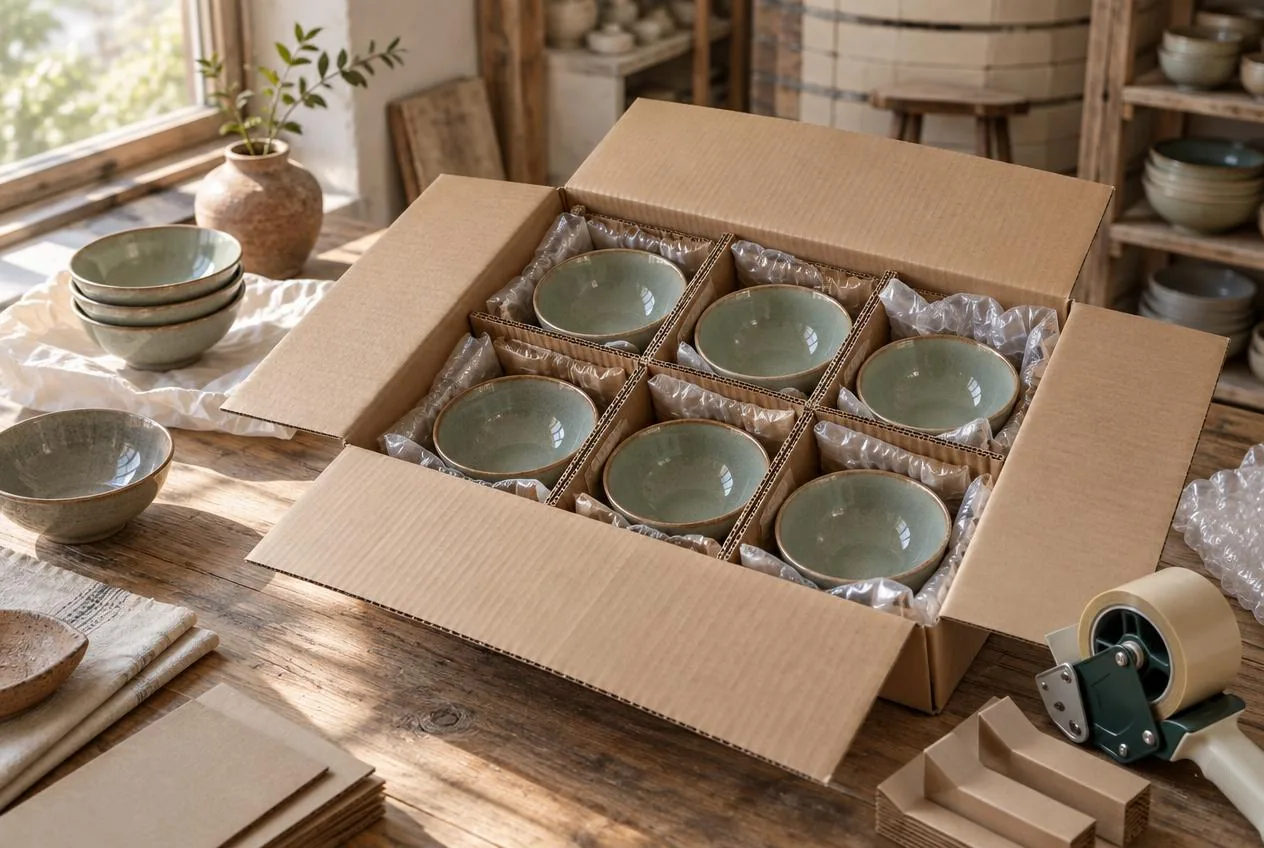
Cushioning is where ceramic packaging is won, and the two workhorse materials — inflatable air column bags and honeycomb paper wrap — do different jobs. Choosing by habit instead of by piece type is how brands end up with mugs wrapped in the wrong material and a breakage rate to match. This guide compares the options honestly, maps each material to the ceramics it protects best, and shows where the layering rule beats any single material.
Two materials, two mechanical jobs
Honeycomb wrap is kraft paper expanded into a cellular structure. Its strengths are contact protection and presentation: it wraps tight, it cannot deflate, it resists abrasion, and it reads as premium paper packaging to the customer opening it. Its weakness is energy absorption — paper compresses and stays compressed, so on a hard drop it bottoms out faster than engineered plastic cushioning. Air column bags invert that profile: rows of inflatable LDPE chambers molded around the piece, each an independent air spring. They absorb shock exceptionally well and immobilize the item inside the carton. Their weaknesses are mechanical vulnerability — one punctured chamber loses its column — and a bulky flat footprint before inflation.
Honeycomb protects surfaces; air columns protect against drops. Ceramics need both jobs done, which is why professionals layer them.
The comparison table
| Property | Honeycomb kraft wrap | Air column bags | Bubble wrap (PE) | EPE foam / corner protectors |
|---|---|---|---|---|
| Primary job | Contact and surface protection | Shock absorption and immobilization | General cushioning | Edge, corner and stacking support |
| Drop performance | Modest — compresses permanently | Strong — independent air chambers | Good while intact | Strong at corners, not full-face |
| Puncture behavior | Tolerant — tears but keeps working | Weak point — a punctured chamber deflates | Loses cells when punctured | Tolerant |
| Presentation to customer | Premium paper look | Industrial, functional | Familiar, unremarkable | Invisible in outer layers |
| Typical role in the pack | First layer, piece wrap | Second layer, cavity fill | Alternative second layer | Pallet and carton reinforcement |
Read the last row first: in professional practice these materials are not competitors but layers. The standard ceramic pack — piece wrap, then cushioning, then the structural carton — uses honeycomb or bubble as the contact layer against the glaze, air columns as the shock-absorbing cavity, and five-layer reinforced corrugated as the shell. Asking "air pillows or honeycomb" is like asking "brakes or tires": the answer is both, each doing its own job.
Match the material to the piece
| Ceramic type | Vulnerability | Recommended layering (typical) |
|---|---|---|
| Mugs and cups | Handles snap on corner impact | Honeycomb wrap on the handle, then a molded air column bag per mug |
| Plates and bowls | Rims chip on edge impacts | Wrap each piece, interleave, pack on edge with columns filling the cavity |
| Teapots | Spout plus handle, two projections | Wrap spout and handle separately, then column bag, snug in a five-layer carton |
| Palletized sets (sea/rail) | Corner crush, load shift | Unit packs as above plus EPE corner protectors and IPPC-compliant crating |
The mug row is worth dwelling on because mugs are the highest-volume ceramic in ecommerce — see the category on our mugs and cups page. A mug is a hollow cylinder with a lever bolted to it; the handle is a stress riser that corner drops exploit. Honeycomb alone leaves the handle flexing against the cavity wall; an air column alone lets the raw plastic bear on the glaze. Wrap-then-column is the sequence that handles both failure modes.
Cost and operational trade-offs
Material price per piece matters less than three operational costs that hide behind it. Freight weight: paper adds more mass than deflated film, which nudges air-freight bills upward on sample shipments. Warehouse volume: air column film ships and stores flat and inflates at the packing bench, while honeycomb rolls occupy real shelf space either way — a genuine consideration for small fulfillment operations, and one reason per-order dropshipping fulfillment prices cushioning into its fee structure, as our dropshipping guide explains. Failure consequence: a punctured column discovered at the packing bench costs a re-inflate; a punctured column discovered by the customer costs a refund and a review. Buy cushioning for the failure you are preventing, not the one on the invoice.
Whatever the material, the acceptance test is the same: pack a production-intent carton, seal it, shake it. Silence means the pieces are immobilized; any shift means the cushioning layout has a void, and voids are where breakage lives. The full layer system is specified on our global shipping page.
A decision framework
- Parcel journey with multiple handlings? Air columns as the second layer are non-negotiable; add honeycomb contact wrap on glazed and projected surfaces.
- Retail-facing unboxing where presentation sells? Honeycomb as the visible first layer, columns hidden beneath — the customer sees paper, the physics gets plastic.
- Sample shipments by air? Honeycomb-led wrapping keeps weight down on small parcels; columns for any piece with a handle or spout.
- Palletized sea or rail cargo? The question changes: corner protection and IPPC-compliant crating join the stack, and the inner materials stay as above.
- One material only, budget forcing a choice? For handle-bearing pieces take the columns; for flat rim-bearing pieces take honeycomb plus tight interleaving and a smaller cavity.
Frequently asked questions
Is honeycomb wrap enough on its own for ceramics?+
For sturdy pieces in short, gentle journeys, it can be. For anything with a handle, a spout or a thin rim — which is most tableware — honeycomb works as the contact layer under a real shock absorber, not as the whole system. Compressed paper does not rebound on a hard drop.
What happens if an air column bag punctures in transit?+
One deflated chamber removes that column's shock absorption, which is why piece-level protection still matters beneath the bag. Quality columns are multi-chamber by design so a single puncture is localized — but the wrap layer underneath is the redundancy that keeps a puncture from becoming a break.
Which material is better for brand presentation?+
Honeycomb kraft reads as considered, premium paper packaging; air columns read as industrial. The common solution is layering: honeycomb as the visible first wrap, columns doing the structural work underneath. Customers remember the paper; claims files record the columns.
Does cushioning choice affect freight cost?+
Modestly, through weight and volume. Paper adds mass that matters most on air parcels; column film ships flat and inflates at the bench, saving storage. Neither effect outweighs the cost of a breakage event — price cushioning against the loss it prevents.