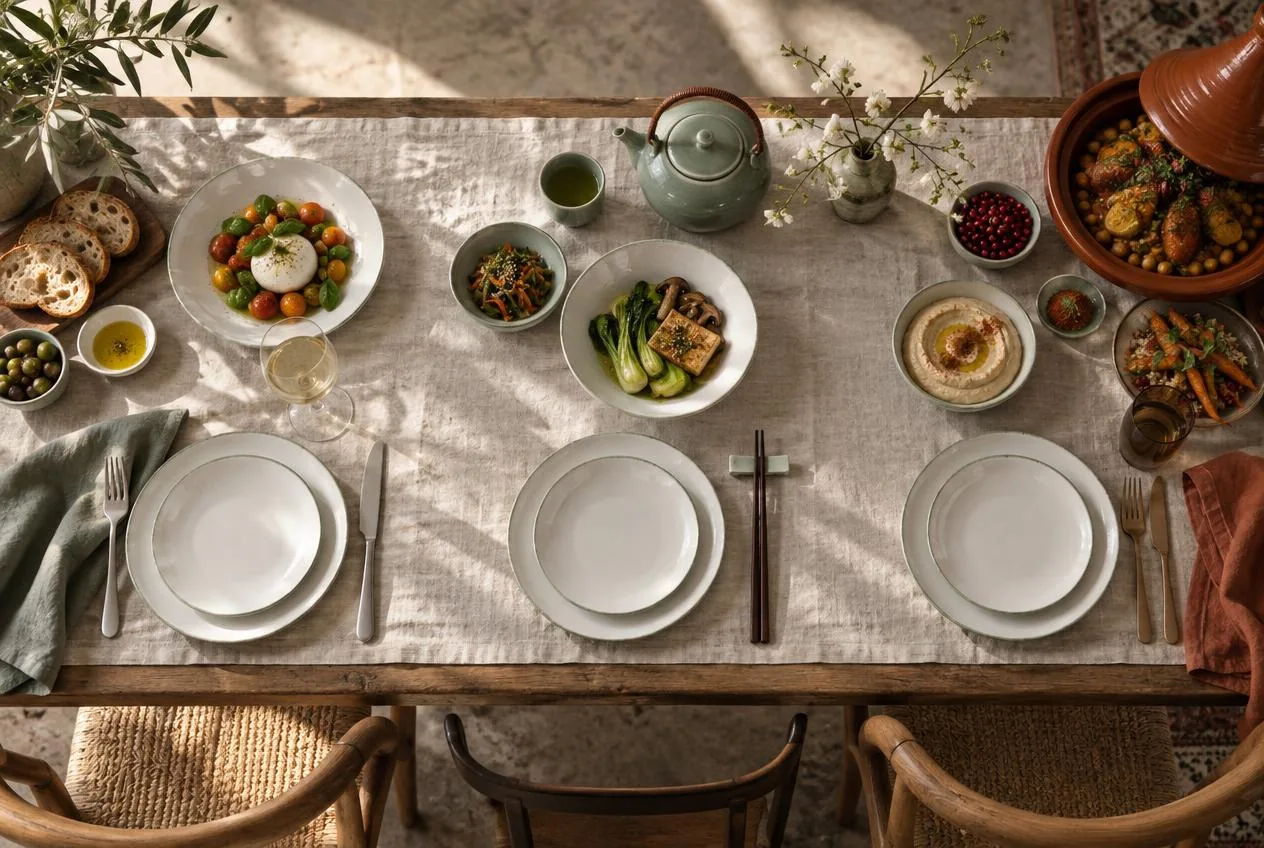
The Nordic tableware shelf has a look — matte stoneware, muted glazes, honest forms — and a rulebook that is stricter than it appears: EU-member Nordics now sit behind the 79.0% anti-dumping duty, and regional buyers often test to German LFGB limits regardless of what the law in their capital requires. This guide translates the Nordic aesthetic into a supplier-side brief: which bodies and glazes to build, which compliance target to sample against, and how rail freight fits the region's replenishment math.
The design brief: what matte stoneware is doing up north
Nordic minimalism in tableware is not an absence of decisions; it is a very specific set of them. The body is usually stoneware — fired hard enough to resist chipping, heavy enough in the hand to feel honest, with a texture that photographs beautifully in the low, raking light of northern homes. The glaze is matte or satin, in a palette drawn from the landscape: oat, ash grey, moss, slate blue, charcoal, unglazed-ring stoneware bases. Decoration, where it exists, is restrained — a reactive glaze doing the visual work on its own, a simple rim line, or nothing at all. Shape logic favors pieces that stack, nest and serve double duty, because Nordic kitchens prize storage efficiency as much as beauty.
For a supplier, the operational heart of this brief is the reactive glaze. Reactive finishes produce the subtle color movement that makes matte stoneware feel alive, but they vary piece to piece, and in northern European retail that variation must be contracted, not excused. The working method is to agree a written variation band at the golden-sample stage — which tone edges, which mottling density, which rim characteristics are in and out of spec — so that "each piece is unique" becomes a specification the buyer signed. Reactive-glaze stoneware sets in the 12-piece configuration are the format we build most often against this brief, with open-stock bowls and mugs layered behind them for repeat purchase.
The duty line runs through the Nordic capitals
The Nordic region is not one customs territory, and the difference now matters more than ever. Denmark, Sweden and Finland are EU member states: Chinese ceramic tableware entering through their ports pays the uniform 79.0% anti-dumping duty under Regulation (EU) 2026/274, exactly as it would in Rotterdam. Norway and Iceland sit outside the EU customs union and apply their own import schedules, which we confirm per consignment with the importing party's broker rather than generalizing. The planning consequence is stark for the EU-member three: at 79.0% on customs value, the duty is the largest single line in landed cost, and assortment decisions — how much decoration, which body, which price tier — have to be made with that line visible. A restrained decoration on a good body is not only the Nordic aesthetic; at a uniform 79.0%, it is also the arithmetic. We track the measure, and its pending legal challenge, on the tariff hub.
Compliance: sample to the stricter target
The legal baseline for EU-member Nordics is EC 84/500/EEC — flatware at 0.8 mg/dm² lead and 0.07 mg/dm² cadmium, vessels at 4.0 and 0.3 — with the CE marking and Declaration of Conformity obligations added by Directive 2005/31/EC. But regional buying practice often sets a higher bar: Nordic retail groups frequently write German LFGB limits into vendor specifications, treating them as the industry's gold standard, because one strict yardstick simplifies governance across a multi-country footprint. The supplier-side answer is to ask which benchmark applies before the first glaze trial, then sample the glaze system for that target from the start. Underglaze decoration and lead-free glaze systems are the structural choices that make either target reachable — color sealed beneath clear glaze carries inherently lower migration risk than anything applied on top, which is why underglaze lines dominate the programs we prepare for northern European buyers. That documentation structure is built into our sampling workflow rather than assembled after shipment.
Freight: rail as the Nordic middle path
For EU-member Nordics, the China-Europe land bridge is a practical replenishment route: rail typically runs 18-35 days from China at roughly one third of air cost, reaching continental European hubs before a short final leg north. Air freight, typically 7-15 days from China, covers samples, testing submissions and in-season top-ups. Ocean remains the choice for full-container programs with long horizons. Whatever the tier, packing discipline carries the economics: unprofessional packaging on fragile goods runs around 5-8% breakage across the industry, and a multi-week land leg through temperature swings is exactly the environment where under-engineered cartons reveal themselves. Palletized loads travel with foam corner protection, IPPC-treated timber or plywood crating, and carton stacking plans reviewed before loading, not after the first damaged pallet.
Program shapes that fit the region
- Reactive-glaze matte stoneware, 12-piece sets, in a controlled palette — the lifestyle-tier anchor.
- Open-stock bowls and mugs in core glazes — the repeat-purchase layer that keeps a brand alive between set launches.
- Everyday white porcelain 16-piece sets — the value core, especially fired at 1280-1380°C for dishwasher endurance.
- Celadon and soft-blue underglaze accents — the quiet color story that northern buyers read as considered rather than decorated.
- Teapots and small tea sets for the specialty end, where the format is intimate and the margin tolerates curation.
Checklist before the deposit
- Confirm which customs territory your program enters — EU-member Nordics at the uniform 79.0% duty, Norway and Iceland on their own schedules — and name the duty treatment in the quote.
- Ask whether the buyer spec runs EC 84/500/EEC baseline or LFGB limits, and sample the glaze for that target.
- Agree the reactive-glaze variation band in writing at the golden-sample stage.
- Plan replenishment on rail (typically 18-35 days) and keep air (typically 7-15 days) for trials and top-ups.
- Write the packing standard — cushioning, carton spec, palletizing — into the purchase agreement.
- Assemble the document file — migration report, Declaration of Conformity, consistent identification — before the first entry.
Nordic buyers forgive variation when it is contracted and punish it when it is discovered. The difference between the two outcomes is one paragraph written at the sampling stage — the variation band — and it costs nothing but the discipline to write it down.
Frequently asked questions
Does the EU 79% duty apply across all the Nordic countries?+
It applies in the EU member states — Denmark, Sweden and Finland — under Regulation (EU) 2026/274. Norway and Iceland are outside the EU customs union and apply their own import schedules, which we confirm per consignment. The measure's status is tracked on the tariff hub.
Why matte stoneware for Nordic programs specifically?+
The finish carries the regional aesthetic — tactile, muted, honest — while stoneware's fired hardness answers the durability and dishwasher expectations behind it. The reactive glaze does the visual work, provided its variation band is agreed in writing before mass production.
Which compliance standard should we test against for the Nordics?+
The legal EU baseline is EC 84/500/EEC with CE and Declaration of Conformity under 2005/31/EC, but many Nordic retail programs specify the stricter German LFGB limits. Ask before the first glaze trial — sampling to the stricter target once costs less than failing onboarding twice.
Is rail freight realistic for Nordic replenishment?+
Yes for the EU-member Nordics: rail typically runs 18-35 days from China at roughly one third of air cost, with a short final leg north. Air, typically 7-15 days, covers samples and in-season top-ups.
To see the bodies and glazes behind this brief — stoneware sets, open-stock bowls and underglaze accents — browse the range, or start from the regional view on the Europe market page. For a Nordic-bound quotation with duty, testing and packing named line by line, request a quote.