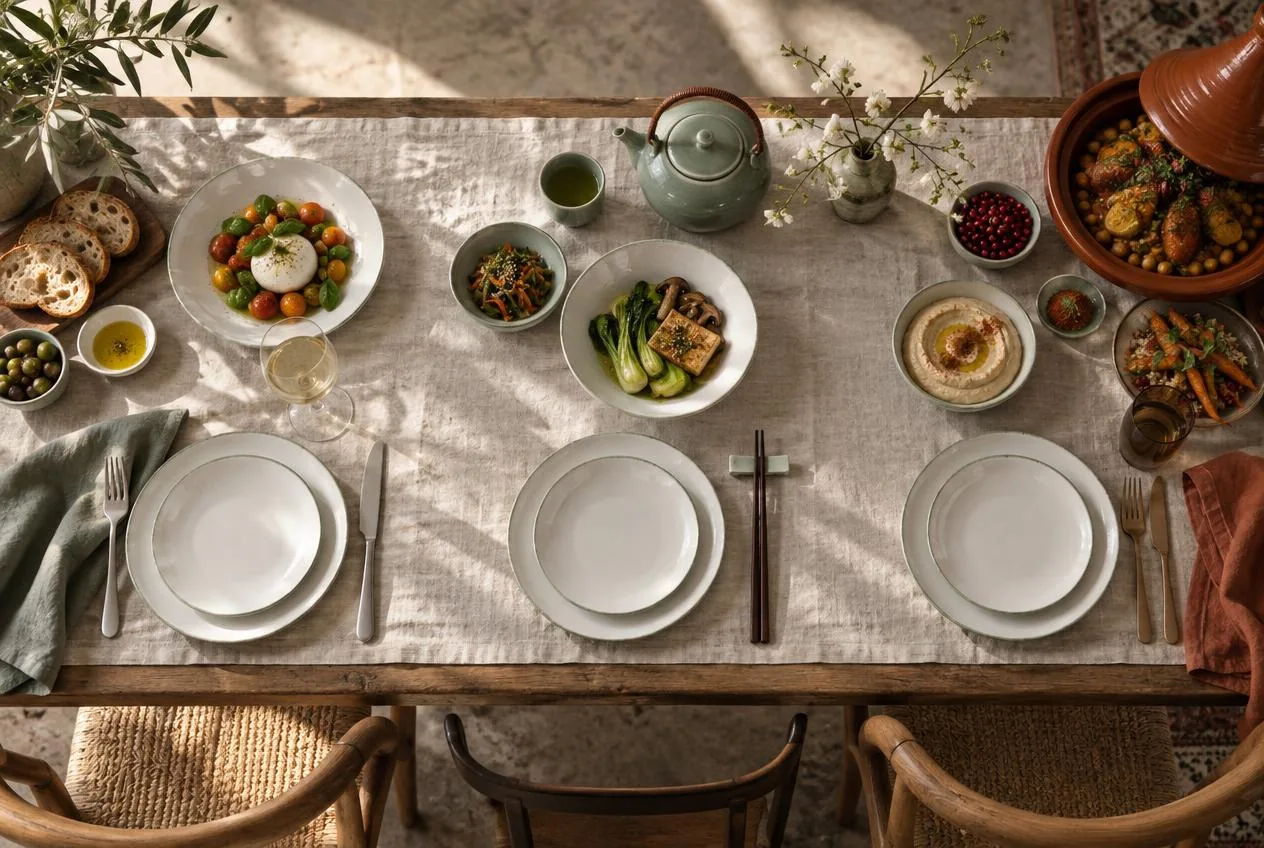
US dinnerware demand looks like one big market and behaves like a ladder: a handful of set sizes, a white core with a texture-led trend layer, and three price bands that most retailers and ecommerce brands occupy without ever writing them down. This guide maps that structure from the supplier side — which set counts the export catalog actually builds, how color trends layer on top of a white base, and what the 2025 duty changes did to the economics behind every band.
Set sizes: the ladder the catalog is built on
Walk any US housewares aisle or ecommerce category page and the same set counts recur, because they map to how American households actually buy: service for four as the default unit, larger service sets for occasions, and open stock to fill the gaps. The China export catalog reflects that demand almost one-to-one — these are the configurations factories tool, glaze and pack for, which means they are also the configurations that carry the lowest unit cost and the fastest reorder path.
| Set size | Typical US role | Body we build it on |
|---|---|---|
| 12-piece | Lifestyle-ecommerce tier; compact first apartments and gifting | Reactive-glaze stoneware |
| 16-piece | The retail anchor — service for four, the US default purchase | High-fired fine white porcelain |
| 28-piece | Wholesale and hospitality-adjacent programs; service for eight with serving pieces | Porcelain with underglaze decoration |
| 56-piece | Gifting, wedding and occasion register; the premium box on the shelf | Bone china with gold-rim decoration |
Two supplier-side notes make the ladder easier to climb. First, bodies matter more than set counts in the quality perception: fine white porcelain fired at 1280-1380°C vitrifies hard, rings clean and survives dishwashers, which is what turns a 16-piece set into a five-star-review machine rather than a returns file. Second, minimums step with customization — stocked shapes typically at 500 pieces per SKU, custom decoration or molds typically 1000-3000 pieces — so the efficient first assortment samples across the ladder at stock MOQ rather than tooling one custom line too early.
Color: white is the core, texture is the trend
The US color market has a stable center and a moving edge. The center is white — everyday white porcelain outsells everything else because it photographs cleanly, matches everything already in the cupboard and never goes out of season; it is the SKU a retailer reorders and the SKU an ecommerce brand builds its catalog page around. The moving edge is texture and glaze character: matte and reactive-glaze stoneware in earth tones carried the last several years of the lifestyle tier, and its appeal is structural, not decorative — the variation reads as authenticity in a category that had become glossy and uniform. Classic underglaze blue holds a durable third position, concentrated in wholesale and heritage-leaning programs where it functions as the category's permanent classic rather than a trend. Seasonal decors rotate on top of all three, and they are discussed properly in a calendar of their own — see our seasonal lines guide for that rhythm.
For a brand, the practical assortment is rarely either/or. The pattern that repeats among programs we build: a white core at the 16-piece anchor, one reactive stoneware line carrying the trend conversation, and one classic accent — underglaze blue or celadon — for depth. Three lines is enough to fill a digital shelf and narrow enough to keep MOQ, glaze inventory and quality control honest.
Price bands: three tiers, built on the same kiln
US retail organizes dinnerware into three working bands — a value band, a mid band and a premium band — and the bands are constructed, not discovered. The value band leans on body economics: high-fired white porcelain at stock shapes and MOQ-driven unit costs, presented in service-for-four packaging. The mid band adds glaze character and brand story: reactive stoneware, matte finishes, coordinated open stock. The premium band buys body and register — bone china fired around 1380°C, gold-rim decoration, larger set counts in gift-weight packaging. The honest way to position across these bands is to let body, decoration and set count do the tiering, because that is what the physical product can defend; a price point asserted above the product's construction gets returned, and ceramics returns are dominated by what arrived versus what was promised.
What 2025 changed underneath the ladder
The ladder stands on a cost base that moved. The de minimis exemption — the duty-free small-parcel channel that quietly subsidized low-value ecommerce dinnerware — was removed on 29 August 2025, so every parcel now enters with duty paid. Section 301 List 3 continues to add 25% at the container level, with the newer reciprocal layers stacked on top, and there is no anti-dumping order on HS 6911 or 6912 to confuse the picture. The result: US landed cost is now a modeled number, not an assumption, and the brands that re-priced early kept their bands intact while their competitors discovered the duty at clearance. The full stack is laid out on our tariff hub, and our standing advice is DDP with duty prepaid so the number is agreed before the deposit.
Fulfillment economics moved too, and they interact with the bands. Ecommerce-bound ceramics face marketplace inbound expectations — each piece individually protected, packed sets surviving a 125 cm drop test on faces, edges and corners — and the industry's unmanaged fragile-goods breakage runs 5-8%, with roughly a third of packaging-related returns traced to transit breakage. In the value band, packaging quality can be the entire margin; in the premium band, it is the unboxing. Replenishment timing closes the loop: air freight typically 5-10 days for trials and top-ups, fast-boat sea typically 15-25 days for confirmed reorders, and both belong on the calendar of anyone selling a Q4-driven category.
Building a first US assortment
- Anchor on a 16-piece everyday white set in high-fired porcelain at stock MOQ — the default US purchase and the cleanest price test.
- Add one 12-piece reactive-glaze stoneware line for the texture conversation and the lifestyle shelf.
- Layer one classic accent — underglaze blue or celadon — before adding any fully novel decor.
- Model landed cost with the full duty stack and duty-paid parcels; quote DDP so the number is fixed before the deposit.
- Write the packing standard — piece-by-piece protection and the 125 cm drop spec — into the purchase agreement.
- Plan the reorder path early: stock shapes at typically 500 pieces per SKU reorder fastest; save custom tooling at 1000-3000 pieces for proven lines.
The ladder is a catalog reality, not a law: a brand can win with a single 16-piece white set executed well. What the structure warns against is the middle — a fifth set size, a fourth color story, a custom mold before the first reorder. Depth of proof beats breadth of assortment in this category.
Frequently asked questions
What dinnerware set size should a US brand launch with?+
A 16-piece set — service for four — is the default US purchase unit and the strongest first anchor. A 12-piece reactive-glaze stoneware set is the usual second line for the texture-led lifestyle tier. Browse configured options under dinnerware sets.
Is white dinnerware still what sells in the US?+
White remains the volume core — it photographs cleanly, matches existing cupboards and never dates. Matte and reactive-glaze stoneware in earth tones is the durable trend layer on top, and classic underglaze blue holds the heritage end. Most successful assortments run white core plus one trend line plus one classic accent.
How do 2025 tariff changes affect a US dinnerware launch?+
Two ways: Section 301 List 3 adds 25% at the container level with newer layers stacked on, and the de minimis duty-free parcel channel closed on 29 August 2025, so every parcel enters duty-paid. Model the full stack before pricing — the background is on our tariff hub.
What MOQ should we plan per SKU?+
Stocked shapes typically carry a 500-piece MOQ per SKU, which suits a test-then-scale assortment. Custom decoration or custom molds typically run 1000-3000 pieces per SKU and belong after the first reorder proves demand.
For the market-level view — duty posture, testing and buyer preferences — see the US market page, and for an assortment quotation with duty and freight named line by line, request a quote.