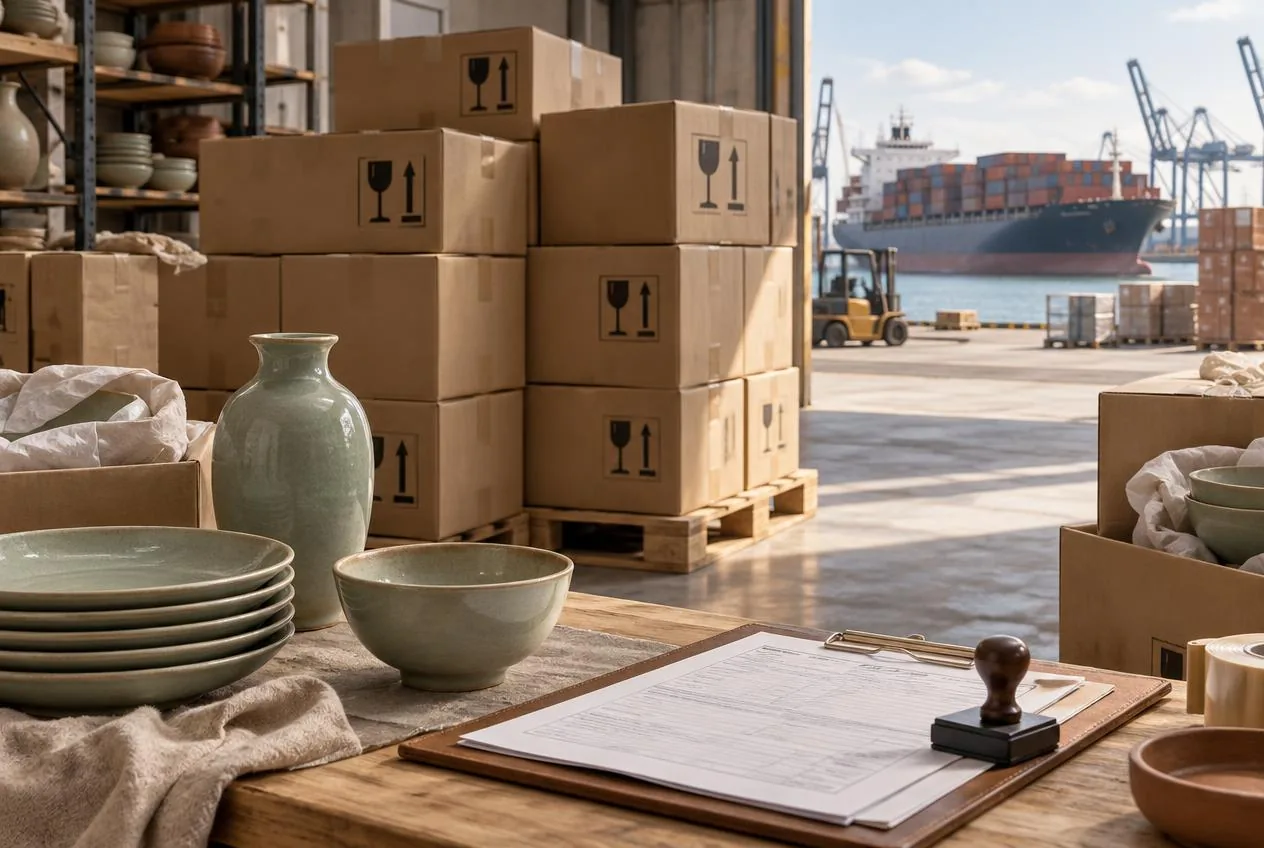
A FOB quotation and a DDP quotation can differ by 40 percent and still describe the same goods. The difference is not the ceramics — it is who pays freight, duty and clearance, and whether the number in front of you already includes the 79.0 percent EU anti-dumping duty or the stacked US tariff lines. This guide shows what each delivery term transfers, when FOB genuinely wins, and how to compare two quotes on a like-for-like basis.
Two quotes that never compare directly
Under FOB — free on board — the seller's job ends when the goods are loaded at the origin port. Everything after that point, from ocean freight to import duty to the truck at your warehouse, is arranged and paid by you. Under DDP — delivered duty paid — the seller hands over the goods at your named destination with import duties paid and the customs work done. The two numbers describe different scopes of work, so comparing them head-to-head is an accounting error, not a negotiation tactic.
Who carries what under each term
| Term | Main carriage | Insurance | Export clearance | Import clearance and duties (incl. anti-dumping) | Import VAT | Typical risk transfer |
|---|---|---|---|---|---|---|
| FOB | Buyer | Buyer | Seller | Buyer | Buyer | On board at origin port |
| CIF | Seller, to destination port | Seller | Seller | Buyer | Buyer | Destination port |
| DAP | Seller, to named place | Seller | Seller | Buyer | Buyer | Named destination place |
| DDP | Seller | Seller | Seller | Seller, prepaid | Seller, by agreement | Named destination |
VAT handling under DDP varies with the seller's tax registration and the parties' agreement, which is why a serious DDP quotation states its VAT treatment explicitly instead of burying it.
Why post-2026 ceramics favor DDP
Three 2025–2026 developments moved ceramics specifically toward duty-paid terms. The EU replaced its 13.1–36.1% range with a single 79.0% anti-dumping duty from 7 February 2026, making under-estimated duty lines catastrophic rather than merely annoying. The US stacked additional tariff layers on top of the 25% Section 301 rate and closed the de minimis exemption, so even parcels now need formal entries and prepaid duties. And the UK's exporter-specific rates demand document-level identity checks that casual importers rarely get right on the first attempt. In each case, the party that ships daily handles the mechanics faster and with fewer expensive surprises — which is the practical argument behind the DDP position described on our global shipping page.
Where FOB still wins
- Experienced importers with infrastructure. If you already have a customs broker, a freight contract and an internal process, FOB lets you shop freight and duty management competitively instead of accepting the seller's bundled margin.
- Full-container programs. At container scale, freight is a meaningful negotiation in its own right, and buyers with volume earn better rates than any seller's standard card.
- Goods that will move again. Shipments routed to free-trade zones, bonded warehouses or onward transfers sometimes fit FOB structures better than destination-door terms.
The only fair comparison: total landed cost
The illustrative example below prices the same US-bound stoneware order two ways. Treat the figures as arithmetic, not a quotation — real duty layers move, as noted on our tariffs hub.
| Cost line (illustrative) | FOB route | DDP route |
|---|---|---|
| Goods value | USD 9,000 | Included in DDP price |
| Ocean freight and insurance | USD 1,600 | Included |
| Section 301 List 3 duty at 25% of goods value | USD 2,250 | Prepaid by seller, named in quote |
| Entry fees and brokerage | Broker-quoted | Included |
| Inland delivery | Quoted separately | Included to named destination |
| Comparable total | About USD 12,850 plus fees and delivery | For example, USD 13,400 all-in |
In this illustration the DDP number is higher, and it can still be the better deal once your own staff time, broker onboarding and the risk of a mis-declared entry are priced in. The point is not that DDP is automatically the smaller number — it is that only the landed total can arbitrate between the two terms.
What to demand from any DDP quotation
- The duty instruments and rates used in the calculation, named and dated — "EU 79.0% per (EU) 2026/274", not "taxes included".
- The HS codes the quote assumes for each SKU.
- The import VAT treatment, stated explicitly.
- The exact named destination where delivery and risk transfer.
- A rate-change clause: what happens to the price if the duty changes between production and release — a question that stopped being theoretical in February 2026.
Duty terms and food-contact compliance are the two places ceramic quotations hide their assumptions. Ask for both in writing — the compliance baseline lives on our quality and compliance page.
Frequently asked questions
Is DDP always more expensive than FOB?+
The DDP headline is usually higher because it bundles more work. Whether it costs more depends on what the seller charges for freight, clearance and duty handling compared with what you would pay arranging them yourself. Compare landed totals, including your own administrative effort, before deciding.
Does DDP include anti-dumping duty?+
A genuine DDP quotation states the anti-dumping duty explicitly — for EU-bound Chinese tableware, the 79.0% rate under (EU) 2026/274. If the quote's duty line is unnamed, assume it is not included and re-price before comparing.
Who is the importer of record under DDP?+
Typically the seller or its customs broker appears on the entry, but the arrangement varies. Confirm in writing who appears as importer of record, because that party carries the legal obligations at the border.
Can we switch delivery terms mid-relationship?+
Yes — delivery terms are set per order, not per relationship. Many importers run FOB on full containers they manage themselves and DDP on air parcels or trial orders. Agree the rate-change handling for each term when you set it.
To see both structures priced honestly for your lanes, request a comparison quote — FOB and duty-inclusive DDP side by side, with the US and European duty layers named.