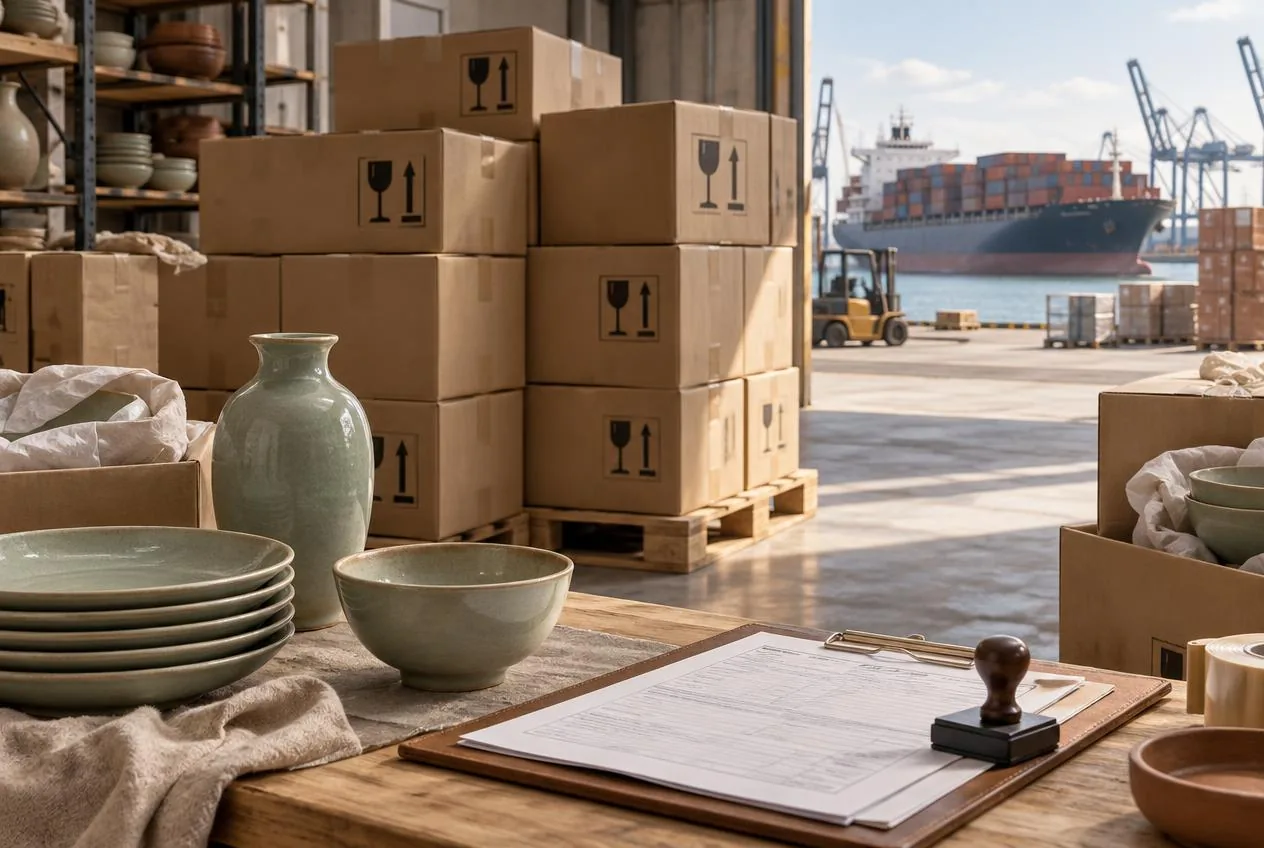
Almost every trade-remedy line that touches a ceramics order starts with a classification decision: porcelain goes in HS 6911, every other ceramic body goes in 6912. Get the six digits right and your duty, statistics and compliance files line up; get them wrong and you inherit border delays, penalties, or the wrong duty regime entirely. This guide walks through the two headings, the neighboring codes where shipments go astray, and a classification routine you can apply to any SKU.
The two headings that matter
| Heading | Material | Typical products | Trade-measure exposure |
|---|---|---|---|
| HS 6911 (6911.10 for tableware and kitchenware) | Porcelain or china | High-fired white porcelain dinner sets, bone china, porcelain teapots and mugs | EU anti-dumping duty of 79.0% under (EU) 2026/274; UK separate rates under AD 2378; US Section 301 List 3 layers |
| HS 6912 (6912.00) | Other ceramic — stoneware and similar bodies | Stoneware plates and bowls, reactive-glaze lines, earthenware-based tableware | The same measure exposure as 6911 in the EU, UK and US actions noted above |
The six-digit level is harmonized worldwide; countries add digits beyond it. In the US, entry uses 10-digit HTS codes, so 6911.10 and 6912.00 become the roots of longer national lines that your broker maps precisely.
Why the split still matters when duties converge
It is tempting to shrug: the EU's 79.0% covers both headings, and the US Section 301 layers hit both. But the porcelain-versus-other distinction still earns its keep. Base MFN rates differ between the two headings in many markets, so the classification decision shapes your cost even where the anti-dumping layers are identical. Trade statistics that your category managers read are kept by heading, which affects how you benchmark assortment performance. And if a future trade action targets one material family, it lands on one heading first — buyers who cannot state their products' heading will learn about it from a customs notice instead of a briefing. Time spent confirming the code before production is an inexpensive investment; the same question answered at the border costs demurrage, reclassification and, in the worst case, penalties.
Neighboring codes where shipments go astray
- HS 6913 — ornamental ceramics. Figurines, decorative vases and giftware sit here, outside the tableware measures. The boundary question — is a decorative bowl "tableware"? — is a classic dispute, and mixed gift boxes that combine usable and decorative pieces deserve a component-level review before entry.
- HS 6907/6908 — ceramic tiles. Construction products, not food-contact goods — but they show how quickly a heading can attract measures: US AD/CVD orders have applied to Chinese tile since June 2020.
- Composite cookware such as porcelain-on-steel. A US anti-dumping order exists on porcelain-on-steel cooking ware (case A-570-833, continued through its fifth expiry review in 2021). Its scope is enamel-on-steel cookware, not ceramic tableware — but the product names confuse buyers constantly, and the distinction matters if your catalog includes any metal-bodied enamel items.
Classifying sets and mixed materials
Dinner sets that combine plates, bowls and mugs of the same ceramic family classify cleanly within 6911 or 6912. Sets that mix materials — a stoneware dinner set with a wooden tray, a tea set with a steel infuser — raise the "essential character" question: customs classifies retail sets by the component that gives the set its essential character, which for a ceramics set is usually the ceramic body. Treat that as a principle to discuss with your broker per destination, not a rule to assume, because national practice varies at the edges.
A five-step classification routine
- Get the material and firing specification from the supplier — body type, glaze, firing temperature range (high-fired porcelain bodies typically fire at 1280–1380°C).
- Decide porcelain or china versus other ceramic. That single answer sets 6911 against 6912.
- Confirm the six-digit code with your customs broker, including the sets-and-mixed-materials questions.
- Map the destination-specific code: 10-digit HTS in the US, national codes elsewhere.
- Print the code on the commercial invoice and keep it identical across every document in the shipment file.
Classification and food-contact compliance are separate files that travel together. A 6911 code answers the tariff question; the FDA 21 CFR 109.16 or EC 84/500/EEC migration limits answer the food-safety question. The compliance overview covers the second file.
Frequently asked questions
Is bone china classified under 6911 or 6912?+
Bone china belongs to the porcelain or china family, so it classifies under HS 6911 — which means it carries the same EU anti-dumping exposure as other porcelain tableware from China.
What code applies to stoneware dinner plates?+
Stoneware is not porcelain or china, so tableware in that body classifies under HS 6912, at the 6912.00 six-digit level — then to the destination country's national digits.
Are HS codes the same in every country?+
The first six digits are internationally harmonized. Beyond six, each country adds its own digits — the US uses 10-digit HTS lines — so the duty-relevant code must be confirmed per destination, not copied between markets.
Where do I check the current US duty for my exact code?+
On the official HTS, reading your 10-digit line together with its Chapter 99 annotations for Section 301 and 2025-onward layers. Verify before contracting — the combined rate changes frequently enough that stored screenshots go stale.
Classification errors are far less costly to fix before production than at the border. If you want your SKUs' codes and duty exposure confirmed as part of a quotation, send us your product list — and see the tariffs hub for how the codes map to current EU, US and UK measures.