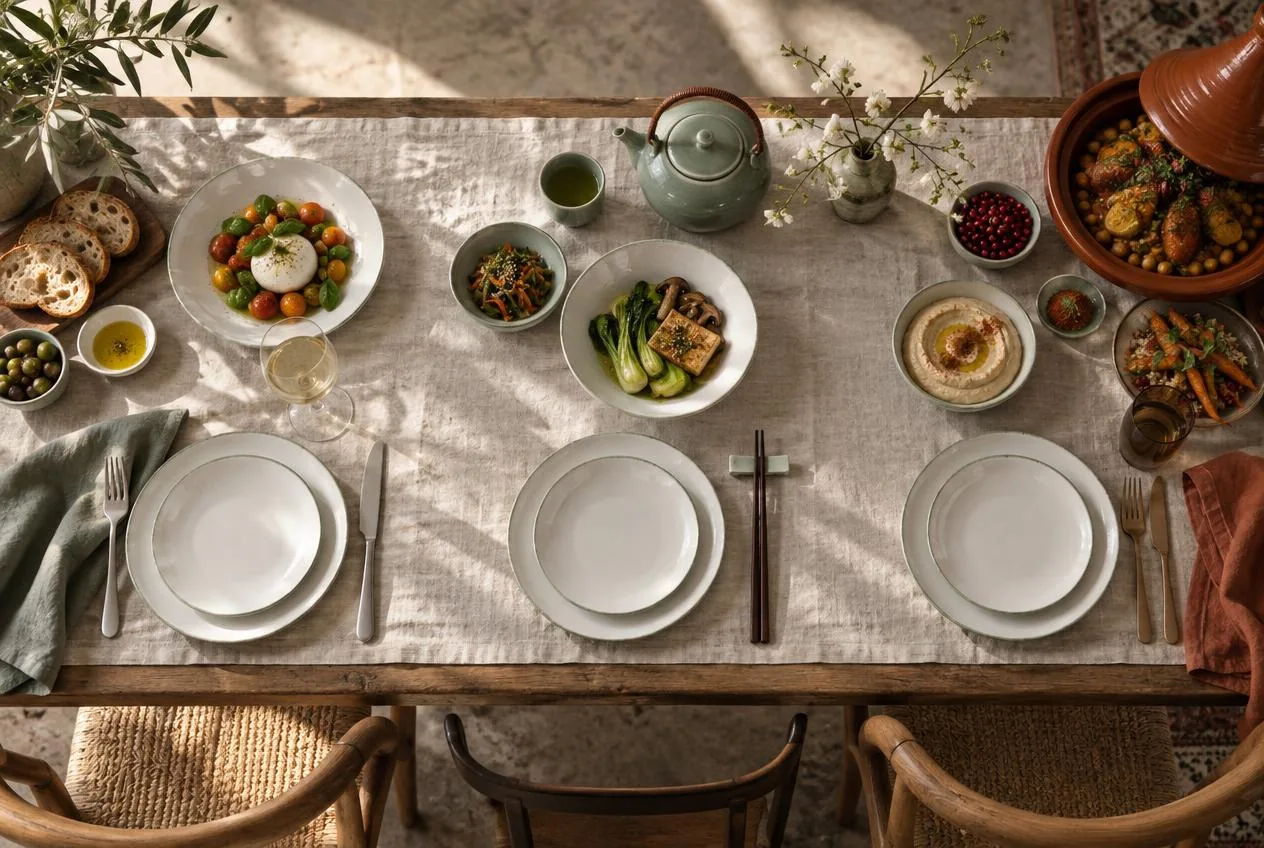
Germany is the most demanding tableware culture in Europe, and the demands are written down: LFGB limits stricter than EU law, a documentation culture that expects files not promises, and a design language that rewards restraint. This guide translates German buyer expectations into supplier-side decisions — which limits to test against, which designs repeat on German shelves, and what the EU's 79.0% duty does to the sourcing math behind it all.
LFGB: the limits German buyers actually quote
EU law sets the baseline for ceramic food contact in EC 84/500/EEC, but German practice runs on LFGB — the German Food and Feed Code — whose ceramics limits (BedGgstV Anlage 14) are stricter than the EU directive. For category 1 vessels up to three litres, the working German thresholds are around 0.2 mg/L lead and 0.02 mg/L cadmium, measured in migration testing. The industry treats LFGB as the gold standard for food-contact ceramics, and its influence reaches well beyond Germany: retailers across Northern Europe copy LFGB limits into specifications because it simplifies their vendor governance to have one strict yardstick.
For a supplier, the practical meaning is this: designing to the EU baseline and then testing to LFGB on request is a strategy that produces failures. Designing for LFGB from the first glaze trial produces files that pass wherever the buyer shops. The structural choices matter more than any single test — lead-free glaze systems and underglaze decoration, where color is sealed beneath clear glaze before the final firing, sit inherently lower on lead and cadmium migration risk than on-glaze decoration ever can. That is why underglaze blue and sealed color-glaze lines dominate the programs we prepare for German buyers, and why we confirm early in sampling whether a program runs the EU baseline or the German limits.
What the 79.0% duty does inside Germany
Germany imports Chinese ceramic tableware under the EU's common trade-remedy umbrella, which since 7 February 2026 has meant the uniform 79.0% anti-dumping duty of Regulation (EU) 2026/274. The duty applies at every German entry point exactly as it does in Rotterdam or Le Havre, and it reorders the landed-cost stack: the duty line now dwarfs freight and clearance, so the sourcing questions that matter are which products justify the duty premium and which quoting method makes the premium visible before the PO is signed.
The quoting question is where German buying culture has already solved a problem the rest of the market is catching up to. A German vendor file expects the price basis stated precisely — duty included or excluded, VAT treatment named, test standards referenced by number. We quote EU and German buyers with the duty and VAT as named lines, which turns the comparison between suppliers into an honest one. Freight adds its own tier choice: air typically 7-15 days from China for samples and trials, rail typically 18-35 days at roughly one third of air cost for replenishment, ocean for full containers. The rail route in particular suits German programs — predictable volumes, tolerance for a multi-week calendar, and a landed cost that does not double-tax itself by flying stoneware.
The design language: restraint that repeats
German tableware taste is often described as minimalist, but that undersells the logic. What repeats on German shelves and in German hospitality is function first: pieces that stack, shapes that wash well, glazes that hide day-to-day wear, decoration that does not date. Matte and satin glazes in muted earth tones, clean white porcelain for the everyday core, underglaze blue as the classic accent, and celadon or muted reactive glazes as the seasonal refresh. Heavy gold rims and ornate multi-color decals read as occasion-ware rather than everyday-ware, and they carry a second penalty under the uniform duty: at 79.0% on customs value, decoration complexity has to earn its place in the landed cost, and restrained decoration usually wins that argument on both aesthetics and arithmetic.
Mug and cup programs deserve special mention because German coffee culture gives them volume and variety at once: open-stock mugs in core glazes, teacups with saucers for the afternoon occasion, and standardized shapes that a café can reorder for years. A shape that stacks and a glaze that survives the dishwasher are the specifications German buyers check before they check the price. Firing discipline supports all of it — fine white porcelain fired at 1280-1380°C vitrifies hard enough to take commercial dishwashing cycles without dulling, which is exactly the performance German food service expects as a baseline, not a feature.
The documentation culture: files, not adjectives
The fastest way to lose a German program is to answer a compliance question with enthusiasm instead of paper. German vendor onboarding expects the complete file: migration test report from a third-party lab on the shipped decoration, Declaration of Conformity under the EU framework, product identification consistent across report, invoice and packing list, and a golden-sample discipline that records glaze, decoration and variation bands in writing. Reactive glazes illustrate the point: German buyers do not reject handmade variation — they contract for it, with an agreed band written down before mass production so that "each piece is unique" is a specification rather than an excuse.
Our own practice follows the same grammar: test reports available upon request, limits referenced by standard number, variation bands agreed at the golden-sample stage. It is less romantic than the craft story, and it is precisely why the craft story sells in Germany — because the file behind it makes the claims checkable.
Checklist for a German-bound program
- Decide the test target at the start: EU baseline under EC 84/500/EEC or the stricter LFGB limits — and sample the glaze system for that target.
- Prefer underglaze or sealed color decoration for anything everyday; reserve on-glaze work for occasion-ware where the program accepts the trade-off.
- Model landed cost at the uniform 79.0% duty with duty and VAT named as separate quote lines.
- Choose rail (typically 18-35 days) for replenishment and air (typically 7-15 days) for trials and top-ups.
- Write the reactive-glaze variation band into the golden sample before mass production.
- Assemble the full document file — report, Declaration of Conformity, consistent identification — before the first entry, not after the first query.
If one German retail group accepts your EU-baseline file, do not assume the next one will. Programs differ in which limits they write into vendor manuals, and re-confirming the benchmark costs one email; failing onboarding costs a season.
Frequently asked questions
Is LFGB compliance mandatory for selling ceramics in Germany?+
German law applies its own stricter ceramics limits through the LFGB framework, so in practice German-market goods are tested against German limits, not only the EU baseline. Many buyers elsewhere in Europe also specify LFGB limits contractually because they are regarded as the gold standard.
Does the EU 79.0% anti-dumping duty apply in Germany?+
Yes. The uniform 79.0% duty under Regulation (EU) 2026/274 is a common EU measure and applies at every German customs entry point, exactly as across the EU. See the tariff hub for the current status.
Which decoration is safest for lead and cadmium migration?+
Underglaze decoration, where color is applied and then sealed beneath clear glaze before the final firing. It structurally lowers migration risk compared with on-glaze decoration, which is why it anchors most compliance-led programs.
What MOQ should we plan for German programs?+
Stocked shapes typically carry a 500-piece MOQ per SKU; custom decoration or custom molds typically run 1000-3000 pieces per SKU. Start narrow, validate sell-through, then invest in tooling.
For the regional picture — duty posture, freight lanes and buyer expectations across the continent — see the Europe market page. The testing and documentation structure behind our German-ready programs starts at quality and compliance, and a duty-transparent quotation is one click away at request a quote.