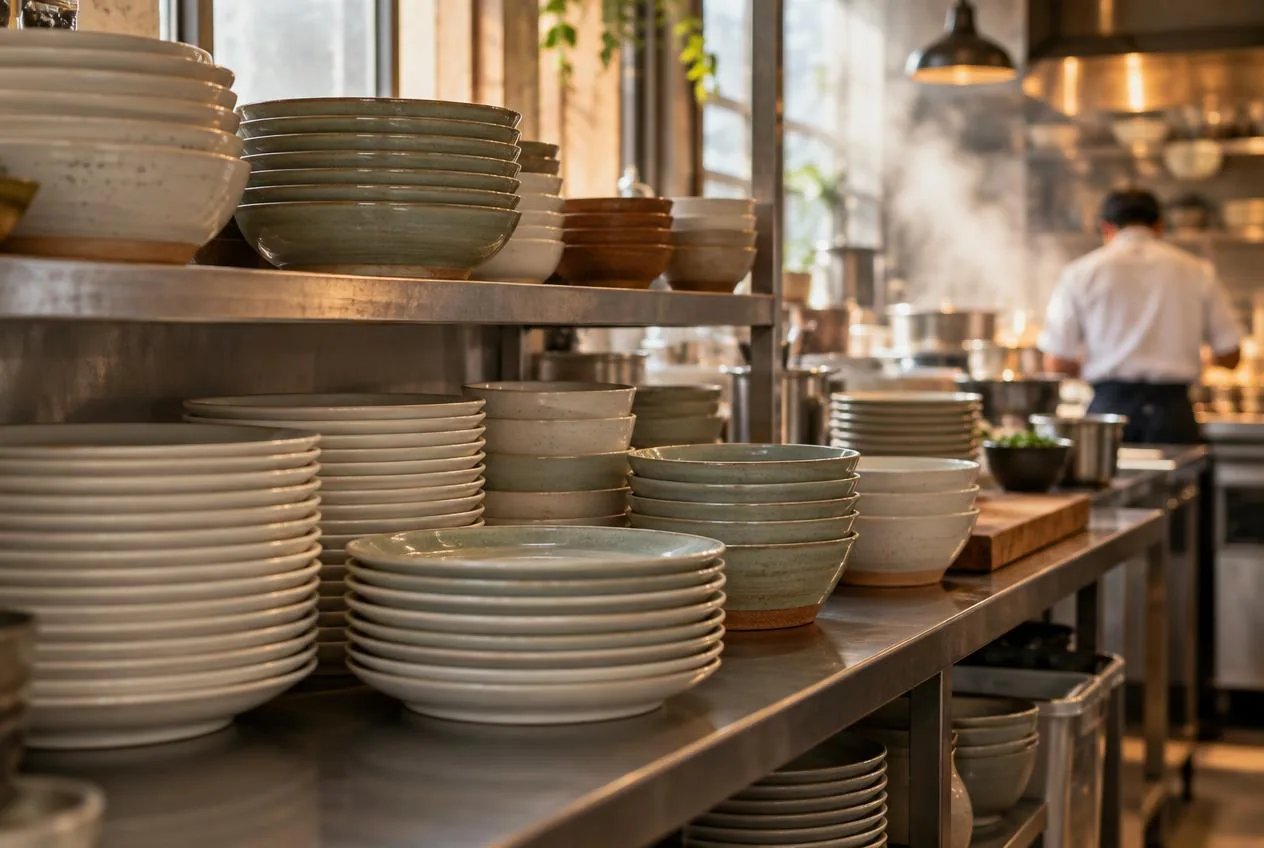
Most restaurant plates do not die serving food — they die in the rack, on the shelf and in the stack. Stackability is the design detail that decides how fast that happens, and it is fully inspectable before you order. For kitchen designers, F&B procurement and anyone specifying ceramics for a working kitchen: the anatomy of stackable ware, what stack height actually saves, and the tests to run before committing.
Where plates die: the rack, the shelf, the stack
Follow a plate through one shift. It is scraped, racked, washed, dried, stacked into a tower and shelved into a space that was counted in centimeters. Every one of those steps is a controlled engineering event for commercial ware and a random collision for domestic ware. Grinding between stacked footrings, rim contact inside rack compartments, and towers that lean as they grow — these account for the quiet majority of ceramic loss in service: the damage that arrives as wear rather than as a dramatic break, and therefore never appears in anyone's incident log.
The anatomy of stackable ware
Stackability is three features working together. First, the footring: raised, recessed and smoothly finished, so a plate rests on its foot and the plate above rests on that foot — glaze never touches glaze under load. Second, the rim profile: rolled or reinforced, with geometry that guides the seating of the piece above instead of catching it. Third, the glaze surface: a hard, well-fired glaze lets stacks seat and separate cleanly, while soft or high-friction glazes drag, wear and mark.
A specification that says only "stackable" has said nothing. The countable version — stacks to a stated number of pieces per format without rim or glaze contact — is what belongs in a purchase order, because it can be verified on a sample table in five minutes. Just as important, the three features compound: a well-finished footring only protects stacks if the rim guides the seating, and both only survive if the glaze does not drag. Evaluate them as a system, not as line items a brochure can claim one at a time.
What stack height actually buys
Stack height compounds quietly. Illustrative only: if a well-designed footring lets a shelf hold stacks of sixteen where an older format held eight, the same storage volume carries twice the par — which is either half the shelving for the same program, or double the buffer in the same cupboard. The same arithmetic runs through the dish area: commercial racks have fixed compartment geometry, and a plate that sits proud of its compartment scuffs on every cycle, while one that seats low protects its own rim thousands of times a year. Neither figure is a standard; both are the kind of count a kitchen can take for itself before ordering.
Testing stackability before you order
- Stack to the claimed height. Take the supplier's stated number and add a few; inspect every rim after unstacking.
- Slide the top piece. Draw one plate sideways across the stack; scuff marks are normal, fresh flakes are not.
- Check the seat. Stacked pieces should sit level without rocking; a rocking stack grinds with every bump of service.
- Fit the rack. Bring a rack compartment dimension to the sample table, or sample plates to the kitchen; proud plates fail slowly and visibly.
- Run a wash week. Two weeks of real dish cycles against a kept golden sample shows footring wear long before it shows in the budget.
Bowls and mugs: the nesting question
Stacking logic differs by format. Plates stack on feet. Bowls should nest so the foot of one rests inside the base of the next without rim or glaze contact — nesting depth is the bowl's version of stack height, and it determines how many portions of storage a dish line really has. Mugs are the hard case: handles collide. Stackable mug designs recess the handle into the body profile, and where that is not available, operators simply buy deeper par on fewer mug SKUs to avoid tall mixed stacks that grind handles against rims. For format-level choices across a program, see our plates, bowls and mugs ranges — each specified with stack geometry in writing.
Specification lines for the PO
Put stackability in writing in three lines. Footring raised, recessed and fully finished. Stackable to a stated number of pieces per format without rim or glaze contact, per the approved sample. Rack compatibility confirmed against the compartment dimension the kitchen actually runs. These lines cost nothing at ordering, and they are the difference between a program that wears evenly and one that quietly grinds its way to early replacement. They sit at the center of how we specify hospitality programs, and they are the first thing to check when two quotations look identical on price.
Frequently asked questions
Does stacking damage porcelain over time?+
Any stack wears; good geometry decides where the wear goes. Engineered footrings and non-contact rims move wear onto surfaces the guest never sees, which is why a well-designed stack still looks presentable after years of dish cycles.
Are stackable plates heavier or uglier?+
No. The recessed footring that enables clean stacking is invisible in service, and reinforcement lives inside rim profiles the guest never notices. Most commercial whiteware reads as clean, classic restaurant porcelain on the table.
How high should plates be stacked?+
To the supplier's stated no-contact height, verified by your own stack test — and no higher. Shelf strength and rack dimensions set the practical ceiling; a tower that leans in service grinds with every bump.
Can existing plates be made to stack better?+
Geometry is fixed at manufacture, so no. Sort existing ware by diameter and footring type so like stacks with like, keep stacks short, and let the next replacement cycle move the program toward engineered stackable formats.